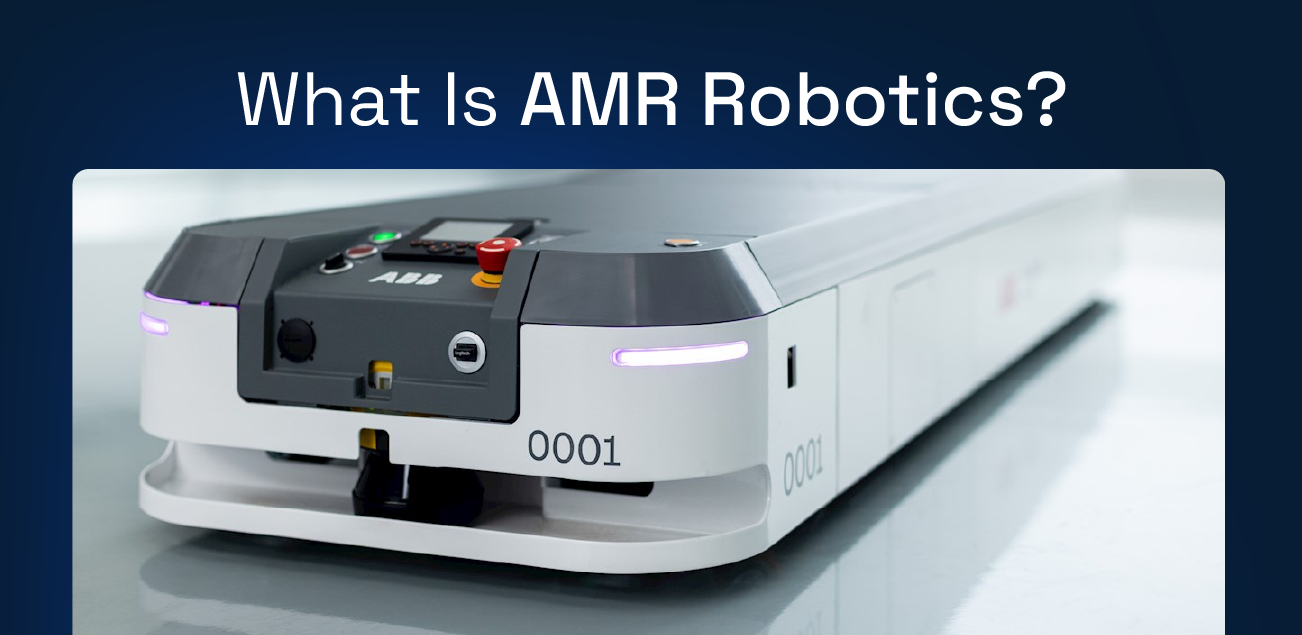
AMR robotics refers to the design, development, and deployment of Autonomous Mobile Robots — robots that navigate and operate in real-world environments without fixed infrastructure or continuous human guidance. Unlike traditional industrial automation that requires conveyors, fixed tracks, or magnetic guides, AMR robotics uses onboard AI, sensors, and mapping technology to give robots the ability to move freely through dynamic environments.
The AMR robotics sector has expanded rapidly from its origins in warehouse logistics into security, healthcare, manufacturing, agriculture, and hospitality. As of 2026, AMRs are among the fastest-growing segments in the global robotics market, projected to reach $205.5 billion by 2030.
Every AMR robotics system is built on three core technical layers working together.
AMRs perceive their environment through LiDAR sensors that create precise 3D maps, RGB and depth cameras for object and person recognition, ultrasonic sensors for close-range obstacle detection, and IMUs that track motion and orientation. These inputs are fused together using sensor fusion algorithms that create a comprehensive, real-time model of the robot's surroundings more accurate than any single sensor alone.
The technical foundation of AMR robotics is SLAM — Simultaneous Localization and Mapping. SLAM allows a robot to build a map of an unknown environment while simultaneously tracking its own position within that map. In practical terms, this means an AMR can be deployed in a new facility, map it autonomously, and begin operating without any infrastructure modification. When the environment changes — a new shelf added, a door closed, a person walking through — the AMR updates its map and replans its route in real time.
Individual AMRs plan optimal routes based on task priority, current obstacles, battery level, and traffic from other robots. In multi-robot deployments, fleet management software coordinates task assignment, traffic flow, charging schedules, and performance monitoring across the entire robot fleet. Advanced fleet systems use AI to predict demand patterns and preposition robots for peak efficiency.
The distinction between AMR robotics and older automation technologies is fundamental, not incremental.
AGVs (Automated Guided Vehicles) require magnetic tape, wires, or reflective markers laid into the floor. They follow fixed routes and stop when blocked. Modifying an AGV route requires physical reconfiguration. Deployment takes weeks. AMRs require none of this. They map any environment in hours, adapt routes dynamically, and update through software alone.
Fixed conveyor systems move materials only along predetermined paths between fixed points. AMRs move freely between any two points in a facility, adapting to changing operational needs without hardware modification.
Warehouse AMR robotics is the largest and most mature application. AMRs transport inventory between storage locations and picking stations, move picked orders to packing and shipping, replenish inventory from receiving to storage, and sort packages for outbound logistics. Amazon, DHL, and major 3PLs operate AMR fleets numbering in the thousands. Amazon deployed its millionth robot in 2025.
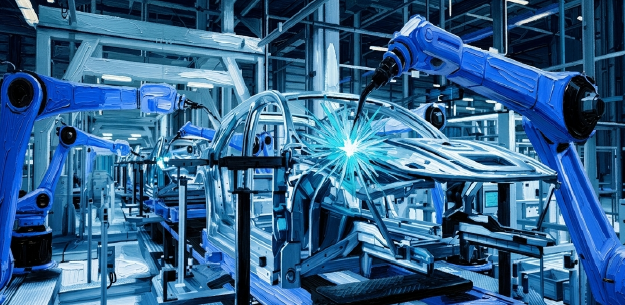
Manufacturing AMR robotics handles material transport between assembly stations, delivers components and tools to work cells, removes waste and finished goods, and performs quality inspection patrol routes. AMRs are increasingly paired with robotic arms — creating mobile manipulation platforms that can both transport and handle materials.
Security AMR robotics deploys robots as autonomous patrol units for corporate campuses, warehouses, healthcare facilities, retail environments, and critical infrastructure. Security AMRs use thermal imaging, HD cameras, two-way audio, and environmental sensors to detect threats, document incidents, and alert security operations centers in real time.
Hospital AMR robotics handles medication delivery from pharmacies to nursing stations, laboratory sample transport, linen and supply distribution, and waste disposal. Healthcare AMRs operate in environments with strict hygiene requirements and integrate with nurse call and hospital information systems.
Unitree Robotics: The highest-volume humanoid and quadruped AMR manufacturer globally, shipping over 5,500 humanoid robots in 2025 with 60% gross margins at $25,000 price points.
Boston Dynamics: The Spot quadruped AMR is deployed for industrial inspection, security patrol, and construction monitoring across major enterprises globally. The electric Atlas humanoid is entering limited industrial deployment.
Fetch Robotics (Zebra Technologies): One of the leading warehouse AMR platforms, with large-scale deployments in fulfillment and distribution centers across North America and Europe.
6 River Systems (Shopify): Chuck AMRs deployed across hundreds of fulfillment centers, focusing on collaborative picking operations alongside human workers.
MiR (Mobile Industrial Robots): Danish AMR manufacturer with a broad product line from small payload units to large pallet-carrying AMRs, widely deployed in manufacturing and healthcare.
Locus Robotics: Warehouse AMR specialist focused on order fulfillment, with multi-robot coordination systems designed for high-throughput distribution environments.
The AMR robotics market is one of the fastest-growing segments within the broader $90.2 billion robotics market of 2024. AMR-specific market research places the segment at $4 to $6 billion in 2024, growing at CAGRs between 20 and 30 percent through 2030. Key growth drivers include e-commerce volume growth requiring faster fulfillment, labor shortages in warehousing and manufacturing, declining AMR hardware costs as manufacturing scales, and the maturation of AI-based navigation that has made AMRs reliable enough for 24/7 industrial operation.
A typical AMR robotics deployment follows a structured process. Facility mapping takes hours to days depending on size. Fleet management software integration with existing WMS or ERP systems takes one to two weeks. Staff training and go-live testing adds another one to two weeks. Total deployment timelines from contract to operation typically run four to eight weeks — a fraction of the months required for AGV infrastructure installation.
ROI timelines for warehouse AMR robotics deployments typically run 18 to 36 months, driven by labor cost reduction, error rate improvements, and throughput increases. Security AMR deployments often achieve ROI in 12 to 24 months given the direct labor substitution model.
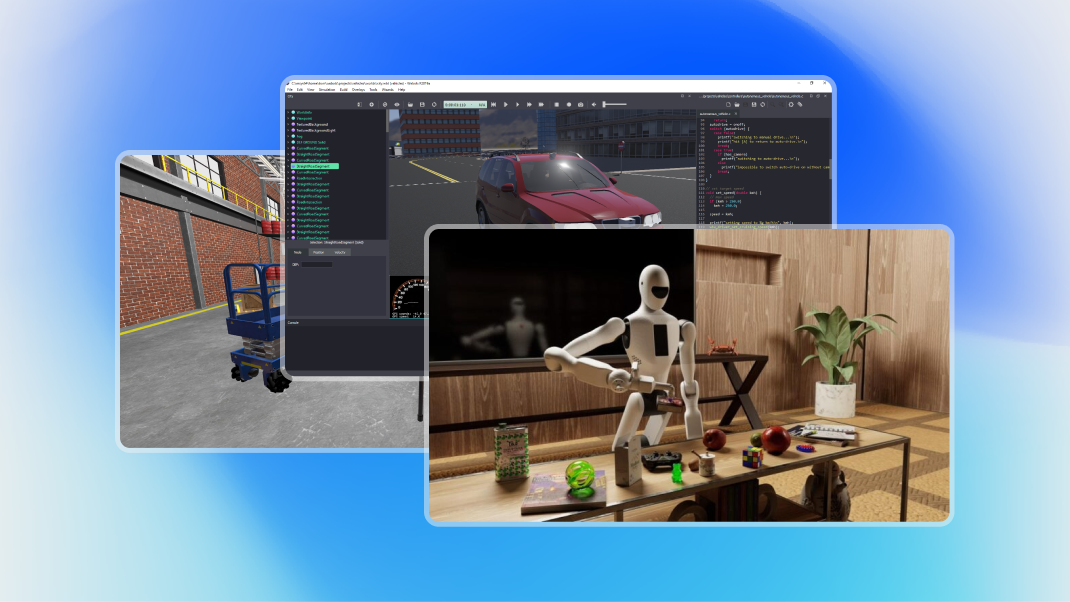
The most advanced AMR robotics deployments in 2026 are built on simulation-first methodology — training and validating robot behavior in a digital twin of the facility before hardware deployment. NVIDIA Isaac Sim enables physically accurate simulation of warehouse and facility environments, allowing AMR fleets to be tested across thousands of scenarios before going live. This approach eliminates the on-site calibration period that traditional AMR deployments require and dramatically reduces the risk of deployment failure.
At Helpforce AI, we apply simulation-first methodology to every AMR robotics deployment, building a digital twin of your facility and validating robot behavior in simulation before hardware arrives.