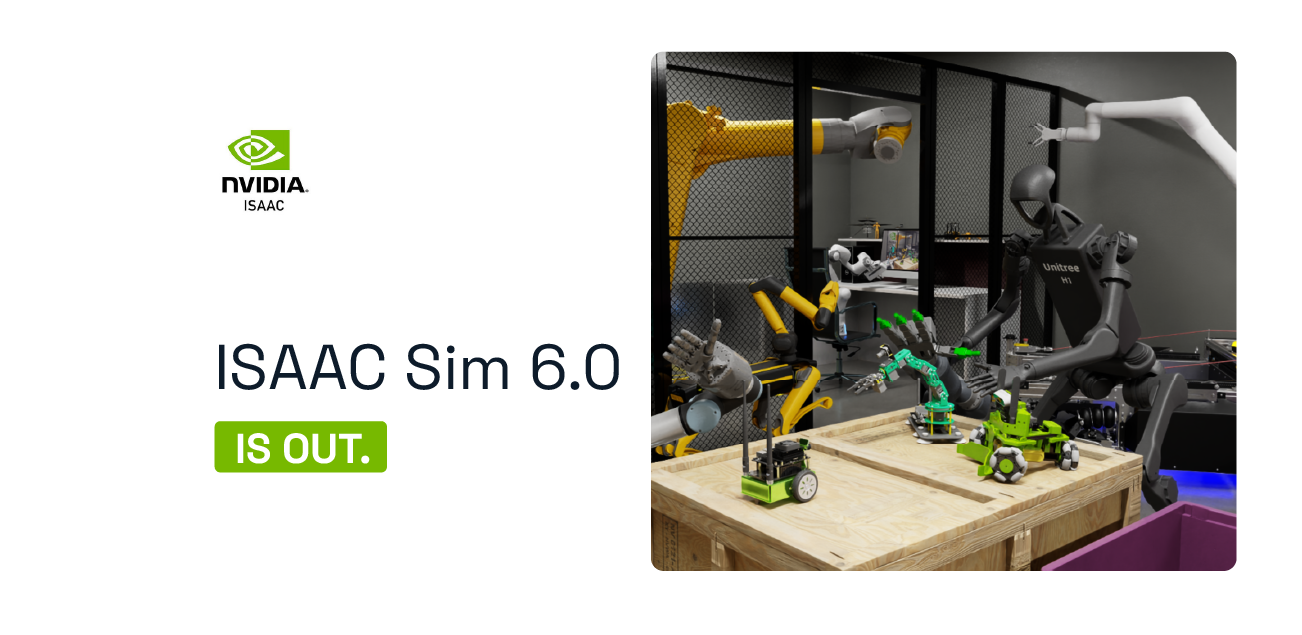
NVIDIA released Isaac Sim 6.0 in April 2026, alongside Isaac Lab 3.0, Omniverse NuRec, and Newton 1.0, the open-source physics engine co-developed with Google DeepMind and Disney Research. The release did not get the mainstream coverage it deserved. If you are building robots, or thinking seriously about deploying them, this matters more than most announcements from the past year.
I want to explain why, from the perspective of someone who runs production robotics deployments on this stack.
The core capability improvement in Isaac Sim 6.0 is rendering fidelity and physics accuracy working together at a level that previous versions could not sustain simultaneously. The sim-to-real gap has always been a two-headed problem. The visual gap: training data generated in simulation does not look like real camera footage, so perception models trained in sim fail on real hardware. The physics gap: simulated contact dynamics do not match real-world material behavior, so manipulation policies trained in sim fail to generalize to physical objects.
Isaac Sim 6.0 addresses both. The photorealistic ray-tracing pipeline generates synthetic training images that are visually indistinguishable from real camera feeds. Newton 1.0 provides GPU-accelerated rigid and flexible body physics with accurate collision detection and realistic object contact that matches real-world behavior more closely than any previous open physics engine.
The practical result, and this is what matters for deployment, is that policies trained in Isaac Sim 6.0 transfer to physical robots with less real-world fine-tuning than any previous version required. The on-site calibration period that has historically been one of the most expensive and time-consuming parts of a robotics deployment is getting shorter.
Isaac Sim 6.0 is the environment. Isaac Lab 3.0 is the training framework. The distinction matters because a lot of robotics teams confuse the two.
Isaac Lab 3.0 is where you run reinforcement learning, imitation learning, and policy validation. It integrates natively with GR00T N1.7 for foundation model fine-tuning, connects to NVIDIA's Cosmos world models for domain randomization at scale, and runs Software-in-the-Loop testing where your robot's control stack is validated in simulation before touching hardware.
The Software-in-the-Loop capability is underutilized by most teams. It lets you run the actual robot software stack, not a simplified model of it, against the simulated environment. If there is a bug in your control logic, a timing issue in your sensor fusion, a failure mode in your path planner, SIL finds it in simulation before you discover it after hardware ships.
We use this extensively in our deployments at Helpforce AI. The debugging cycle in simulation is measured in minutes. The debugging cycle on physical hardware in a client facility is measured in days. The economics of SIL are not subtle.
Newton 1.0 deserves its own section. Co-developed by NVIDIA, Google DeepMind, and Disney Research, built on NVIDIA Warp and OpenUSD, and released under Linux Foundation governance as a fully open-source project, Newton is the most capable open physics engine ever released for robotics.
What makes Newton significant for the sim-to-real problem is dexterous manipulation. Previous physics engines modeled rigid body contact reasonably well but struggled with flexible materials, deformable objects, and the finger-level contact dynamics that manipulation tasks require. Newton handles all of these. It is optimized specifically for the kinds of contact-rich manipulation tasks that humanoid and dexterous robot hands need to perform.
For teams training robots on assembly tasks, packaging, small parts handling, or any task involving grasping irregular objects, Newton 1.0 changes the quality ceiling of what simulation can produce.
At Helpforce AI, we have been running Isaac Sim on production deployments since the 4.x era. The improvement from 4.x to 5.x was meaningful. The improvement from 5.x to 6.0, particularly with Newton physics and the SIL improvements in Isaac Lab 3.0, is more significant than any single version jump we have seen.
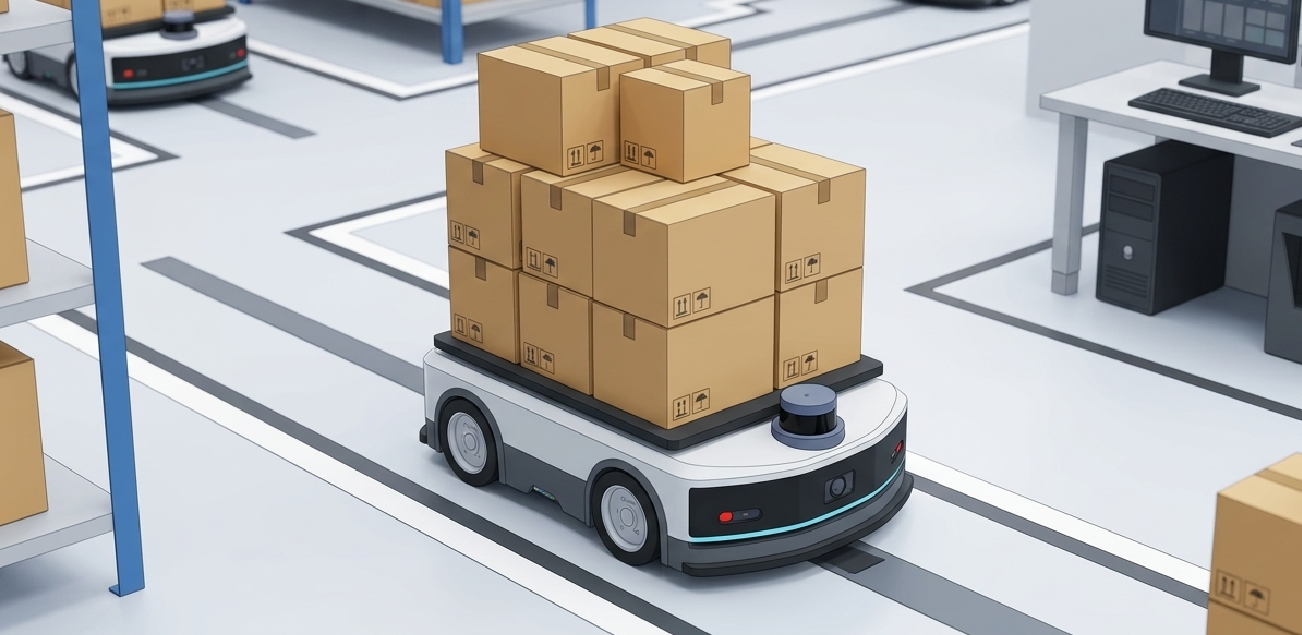
The specific change we are most interested in is the reduction in real-world fine-tuning required after sim-to-real transfer. Our warehouse picking deployments have historically required one to two weeks of on-site calibration after simulation training. With Isaac Sim 6.0 and Newton physics, we are targeting that window at under one week for comparable task complexity. That is not a small efficiency gain. For clients where facility downtime has a real cost, it changes the economics of the deployment.
You can read more about how Isaac Sim compares to Gazebo, CoppeliaSim, and MuJoCo for different use cases, and how we apply the simulation-first methodology across our industrial deployments.
Isaac Sim 6.0, Isaac Lab 3.0, Newton 1.0, and GR00T N1.7 shipping within weeks of each other in early 2026 is not coincidence. It reflects NVIDIA's deliberate strategy of maturing the full stack simultaneously. Jensen Huang described it at GTC 2026 as the beginning of the physical AI era. That framing is not wrong.
The robotics industry has spent a decade waiting for simulation to be good enough to trust for production training. Isaac Sim 6.0 is the clearest signal yet that we have crossed that threshold. The gap between simulation and reality is not gone. But it is smaller than it has ever been, and it is shrinking with each release cycle.
For teams evaluating whether to invest in simulation infrastructure now or wait, the answer from the stack itself is clear. The tools are production-ready. The question is whether you are.