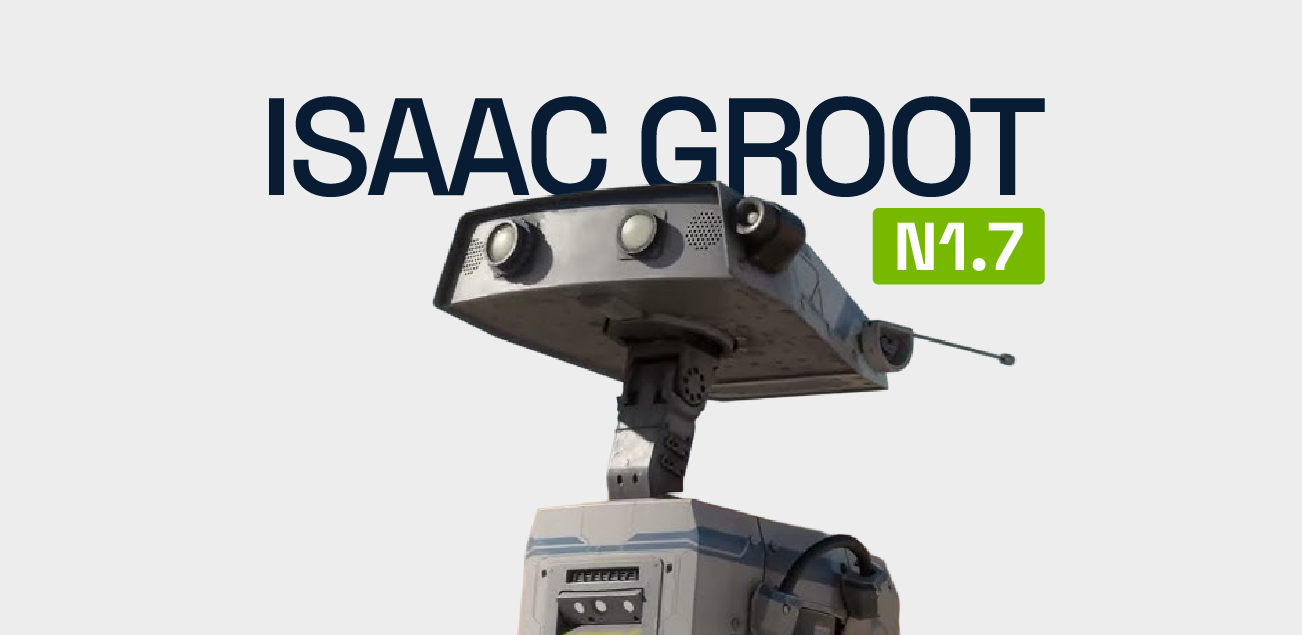
On April 17, 2026, NVIDIA released GR00T N1.7 in early access with a detail that most coverage buried in the second paragraph: it ships under Apache 2.0 licensing. Fully commercially licensable. Production deployments allowed today.
This is the moment the robotics AI stack stopped being research infrastructure and became production infrastructure. That shift deserves more attention than it has received.
GR00T N1.7 is a 3-billion parameter Vision-Language-Action model. It takes a camera image, a language instruction, and the robot's current joint positions and velocities, and outputs continuous motor commands. That description sounds straightforward. What makes it remarkable is the training approach behind it.
Previous versions of GR00T were trained primarily on robot teleoperation data. Humans demonstrating tasks by remotely controlling robot arms. This approach works but scales poorly. Teleoperation is expensive, slow to collect, and limited to tasks a human can demonstrate with a robot in the loop.
N1.7 introduces EgoScale: pretraining on 20,854 hours of human egocentric video. People performing tasks in manufacturing facilities, retail environments, healthcare settings, and domestic spaces, captured from a first-person perspective with hand tracking. The model learns manipulation priors from human behavior and transfers them to robot control through a shared action representation.
The result is a scaling law NVIDIA describes as the first-ever for robot dexterity. More human egocentric data produces predictable, consistent improvements in manipulation capability. Going from 1,000 to 20,000 hours of training data more than doubled average task completion rates. This is the kind of empirical finding that changes research directions across an entire field.
GR00T N1.7 uses what NVIDIA calls an Action Cascade architecture. It separates high-level reasoning from low-level motor control across two systems running in parallel.
System 2 is a vision-language model based on Cosmos-Reason2-2B that processes what the robot sees and the instruction it has received, decomposing complex tasks into subtasks and generating high-level action tokens. System 1 is a 32-layer diffusion transformer that takes System 2's output and the robot's live joint state, then denoises them into precise motor commands in real time.
The practical implication: the model can handle multi-step tasks where the robot needs to reason about what it is doing, not just pattern-match to a previously demonstrated behavior. Small parts assembly, contact-rich manipulation, tasks that require understanding context and adapting mid-execution. These are the tasks that have historically required extensive custom development for each deployment. GR00T N1.7 generalizes across them from a single foundation model.
Before N1.7, teams building on GR00T faced a practical constraint: the model was available for research but production deployment required navigating licensing uncertainty. That uncertainty is gone. Apache 2.0 means you can fine-tune the model on your robot's specific data, integrate it into your deployment stack, and ship it in a production system without a commercial agreement with NVIDIA.
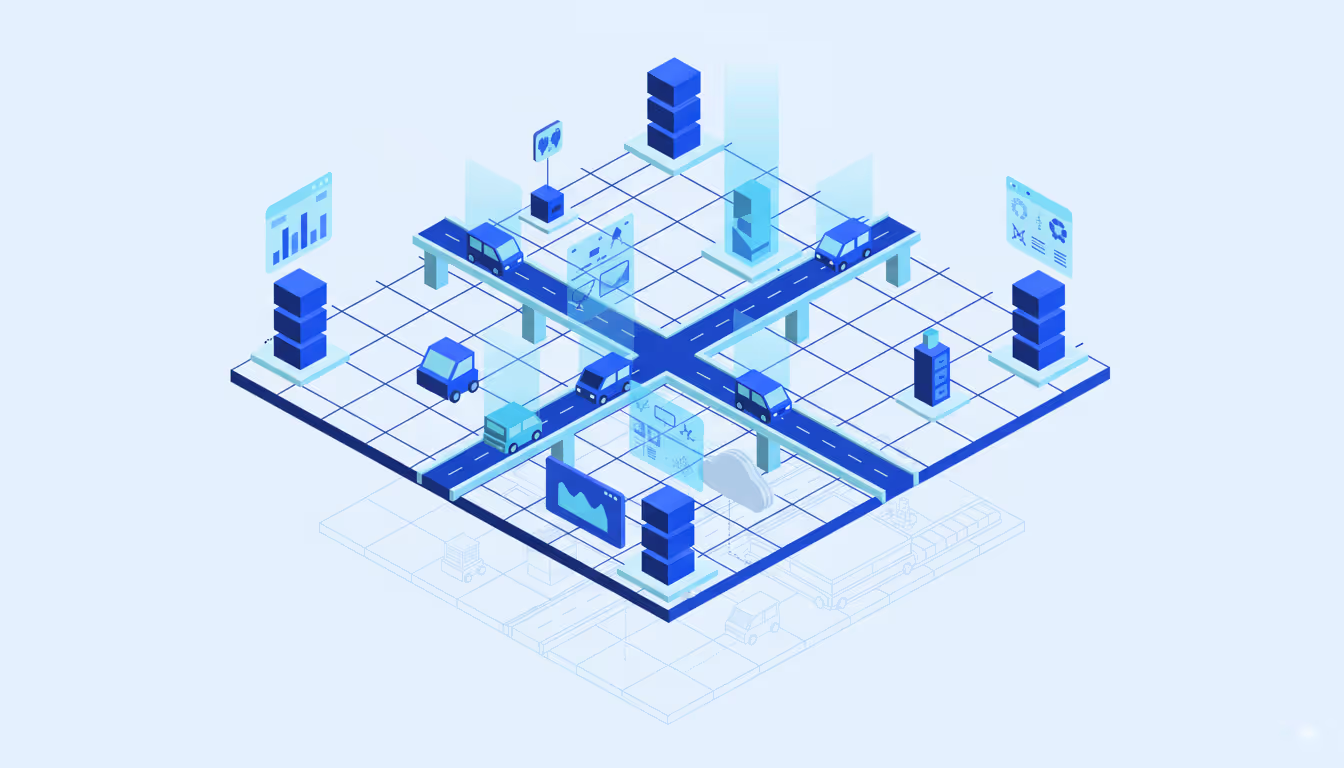
For teams building on NVIDIA Isaac Sim, this closes the last gap in the open production stack. You can simulate your deployment environment in Isaac Sim, generate synthetic training data, fine-tune GR00T N1.7 on your specific tasks and robot embodiment, and deploy. The entire pipeline from simulation to physical robot is now available without proprietary licensing constraints on the AI layer.
At Helpforce AI, we have been tracking GR00T across versions. N1.5 required 20 to 40 demonstrations for effective fine-tuning. N1.7 generalizes better from the same demonstration count because its pretrained priors are richer. For warehouse picking, security patrol with obstacle interaction, and quality inspection tasks, this translates directly into shorter deployment cycles and higher first-attempt success rates on novel objects and environments.
Jensen Huang previewed GR00T N2 at GTC 2026. Built on DreamZero research and a new world action model architecture, it is designed to help robots succeed at new tasks in new environments more than twice as often as current leading VLA models. N2 currently ranks first on both MolmoSpaces and RoboArena for generalist robot policies. NVIDIA has targeted end of year 2026 for availability.
N2 represents a different architecture category from N1.7. Where N1.7 improves on the VLA foundation model approach with better data, N2 uses a world model to simulate the consequences of actions before executing them. This is the direction the field is moving: robots that plan by imagining, not just by pattern matching.
Teams building on the stack today should treat N1.7 as the production-ready foundation for current deployments and track N2 as the architecture that will define the next generation of deployment capability.
You can read more about how Isaac Sim compares to other simulation platforms and the case for simulation-first deployment methodology in our earlier writing.
The robotics AI stack is no longer a research project. It is production infrastructure. GR00T N1.7 with Apache 2.0 licensing, running on Isaac Sim 6.0, deployed on Jetson Thor hardware, is a complete stack for taking a task from demonstration to physical robot operation without proprietary dependencies at any layer.
The operators and engineers who understand this stack now are building a capability advantage that will compound as the hardware availability of humanoid and manipulation robots increases over the next 24 months. The foundation model layer is open. The simulation infrastructure is available. The question is who is building on it.