If you are building a robotics system in 2026, you will encounter three names repeatedly: CoppeliaSim, NVIDIA Isaac Sim, and Gazebo. Each has a legitimate place in the ecosystem. Each is the wrong choice for certain use cases. This article breaks down what each one actually does well, where each falls short, and which one belongs in a serious industrial deployment pipeline.
CoppeliaSim is one of the oldest and most versatile robot simulators available. It was originally developed as V-REP and rebranded as CoppeliaSim under Coppelia Robotics. Its core strength is flexibility: it supports multiple physics engines (Bullet, ODE, Vortex, MuJoCo), has a built-in scripting environment, and offers a large library of pre-built robot models. The free educational version has made it widely adopted in universities across Europe and Asia.
Where CoppeliaSim falls short is in the context of serious industrial AI training. It was designed before GPU-accelerated simulation became the standard, and its rendering pipeline does not produce the photorealistic synthetic data that modern deep learning models require for sim-to-real transfer at industrial scale. If you are training a robot to recognize objects using computer vision in a real warehouse, CoppeliaSim will not generate training data with the visual fidelity needed for reliable transfer to physical hardware.
Best for: academic research, educational robotics, multi-robot scripting experiments, teams that need broad compatibility without GPU infrastructure.
Gazebo is the simulation environment historically associated with ROS (Robot Operating System). For years, if you were building on ROS, you were running Gazebo. The newer Ignition Gazebo (rebranded as just Gazebo in 2022) is a significant architectural improvement over the original, with better modularity and plugin support.
Gazebo's strength is its integration with the ROS ecosystem. If your team is building on ROS 2 and needs a free, open-source simulator that talks natively to your robot control stack, Gazebo is the path of least resistance. It is also well-documented and has a large community.
The limitations are real, however. Gazebo's physics accuracy has historically lagged behind commercial alternatives, though Ignition has improved this. More importantly, Gazebo does not have native GPU-accelerated physics or photorealistic rendering for synthetic data generation. For deep learning-based perception systems that need to transfer from simulation to reality without extensive real-world fine-tuning, this is a meaningful constraint.
Best for: ROS 2 development environments, research teams on limited GPU budgets, mobile robot navigation, basic manipulation research.
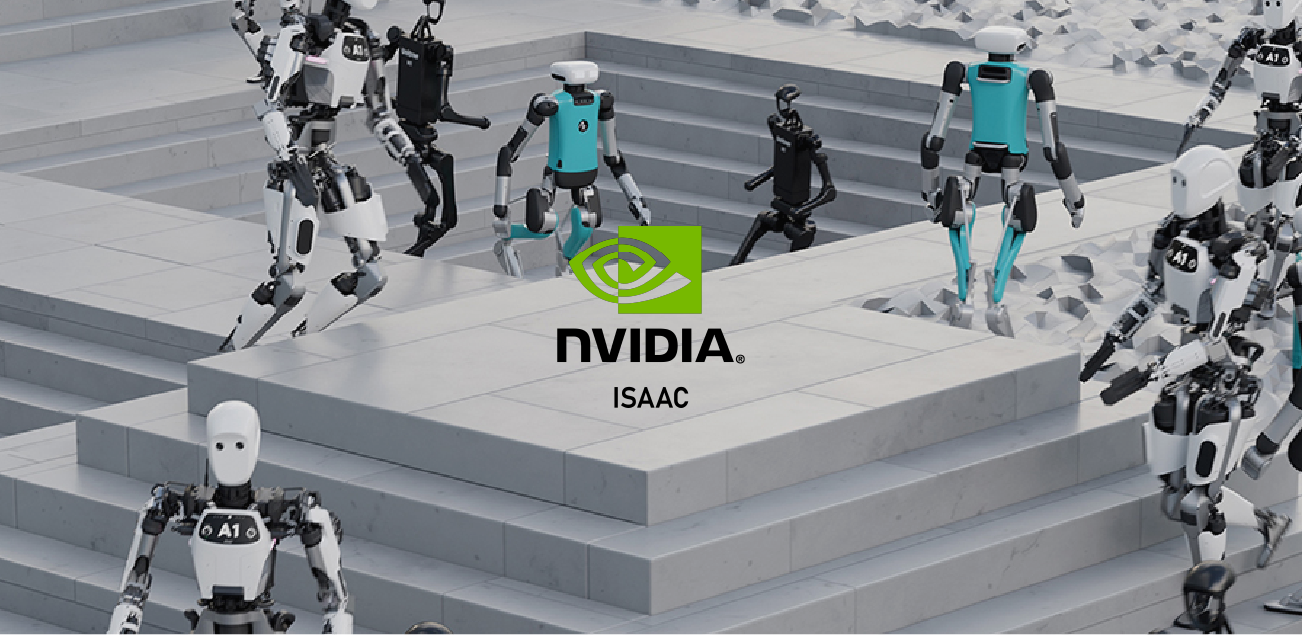
NVIDIA Isaac Sim is purpose-built for the problem that matters most in 2026: training robot AI systems that actually work when deployed on physical hardware. It runs on NVIDIA Omniverse and delivers GPU-accelerated, physics-accurate simulation with photorealistic rendering through ray tracing and path tracing. It generates synthetic training data that is visually indistinguishable from real camera feeds, which is what makes sim-to-real transfer work at scale without extensive real-world data collection.
Isaac Sim is the simulator behind Figure AI's Helix training pipeline, the platform Amazon uses for its fulfillment robotics, and the infrastructure BMW and Siemens use for industrial robot validation. NVIDIA released Isaac Sim 6.0 in April 2026, alongside Isaac Lab 3.0 and the GR00T N foundation models, cementing its position as the production-grade choice for enterprise deployment.
The trade-offs are real. Isaac Sim requires NVIDIA GPU infrastructure. The learning curve is steeper than Gazebo or CoppeliaSim. It is significantly more demanding computationally. And for teams doing purely academic research or simple robot navigation without deep learning perception, it is probably more platform than the use case requires.
Best for: industrial deployment pipelines, deep learning perception training, sim-to-real transfer for manipulation, warehouse and security robot development, any use case where training data quality directly affects physical performance.
CoppeliaSim is the most accessible entry point and the most flexible for scripting and academic research. Gazebo is the right choice for ROS 2 development without GPU infrastructure requirements. Isaac Sim is the right choice when sim-to-real transfer quality is the constraint that determines whether your deployment succeeds or fails.
If you are building a robot that will be deployed in a real industrial environment and the robot's performance in that environment is what matters, Isaac Sim is not the most expensive option. It is the option that reduces the risk of your deployment failing after hardware ships.
At Helpforce AI, we run NVIDIA Isaac Sim for all production deployment pipelines. We have evaluated CoppeliaSim and Gazebo extensively. For warehouse and security robot deployments, where the robot needs to perceive real environments accurately and the cost of a failed deployment is high, photorealistic simulation is not optional. It is what makes the difference between a policy that transfers and one that requires months of on-site calibration.
If you are choosing a simulator for a research project, CoppeliaSim or Gazebo may serve you well. If you are building something you intend to deploy, Isaac Sim is the infrastructure worth investing in.