
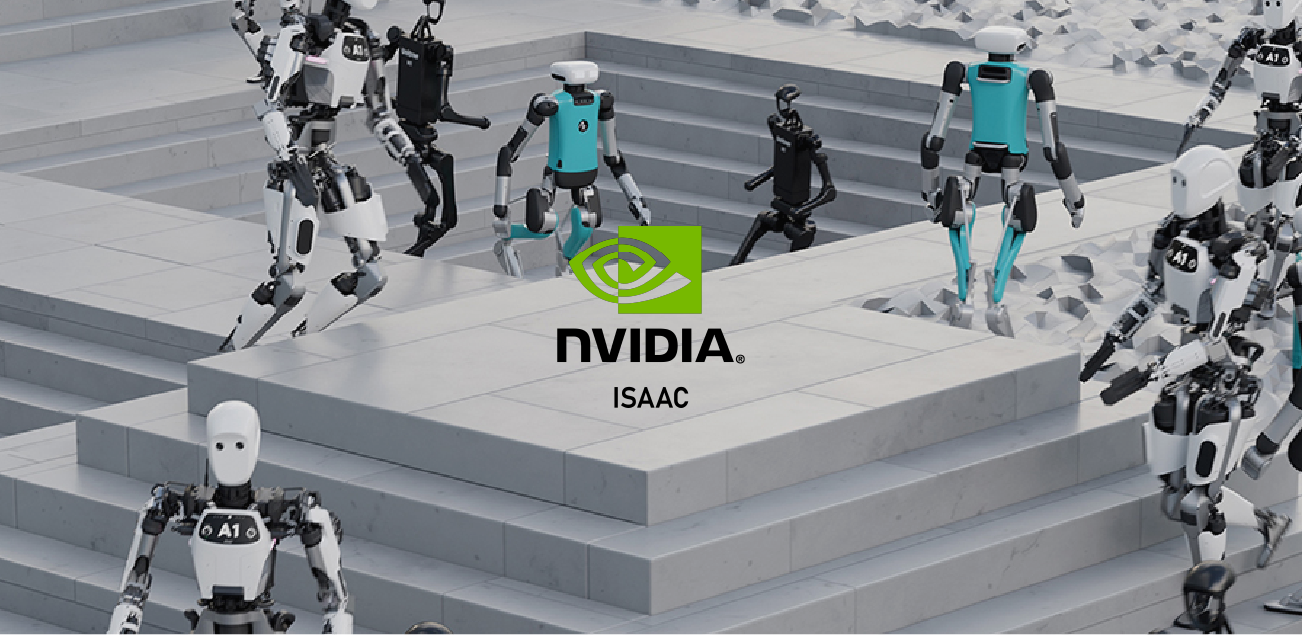
NVIDIA Isaac Sim is the simulation environment used by Amazon, BMW, Siemens, Figure AI, and over 100 other companies to train robots before they deploy on real floors. It runs on NVIDIA Omniverse and delivers 9,200 training samples per second — 16x faster than CPU baselines. The latest Isaac Sim releases have continued to close the gap between simulation and physical reality in ways that directly affect deployment timelines and deployment cost.
The traditional approach to robotics deployment is to ship hardware, calibrate on-site for months, absorb operational disruption, and eventually reach stable performance. It is slow, expensive, and risky because your facility becomes the testing ground.
Simulation-first flips that entirely. You build a digital twin of the facility using point cloud scanning and NVIDIA Omniverse. The robot trains in that virtual environment — thousands of scenarios, every edge case, every protocol — before hardware ships. The reinforcement learning policies trained in simulation transfer zero-shot to physical robots. When the hardware arrives, it already knows your facility.
Isaac Sim provides physics-accurate simulation that matches real-world sensor behavior. Camera feeds, LIDAR returns, depth sensing — all simulated to match the actual hardware specifications of the robot being deployed. This is what makes sim-to-real transfer work at industrial scale. Training in a physically inaccurate simulator creates policies that fail in the real world. Isaac Sim eliminates that gap.
NVIDIA's continued investment in Isaac Lab and Isaac Sim reflects where the industry is going. The companies building on this infrastructure now are building a compounding advantage: every deployment generates data that improves the next one. Every simulation run refines the training policy. Every facility that runs robots feeds the system.
You do not need to be Amazon or BMW to deploy on NVIDIA's simulation infrastructure. At Helpforce AI, we use NVIDIA Isaac Sim to train robots for Pakistan's specific warehouse layouts and security protocols. The same technology. The same methodology. Applied to your specific facility before a single piece of hardware ships.