
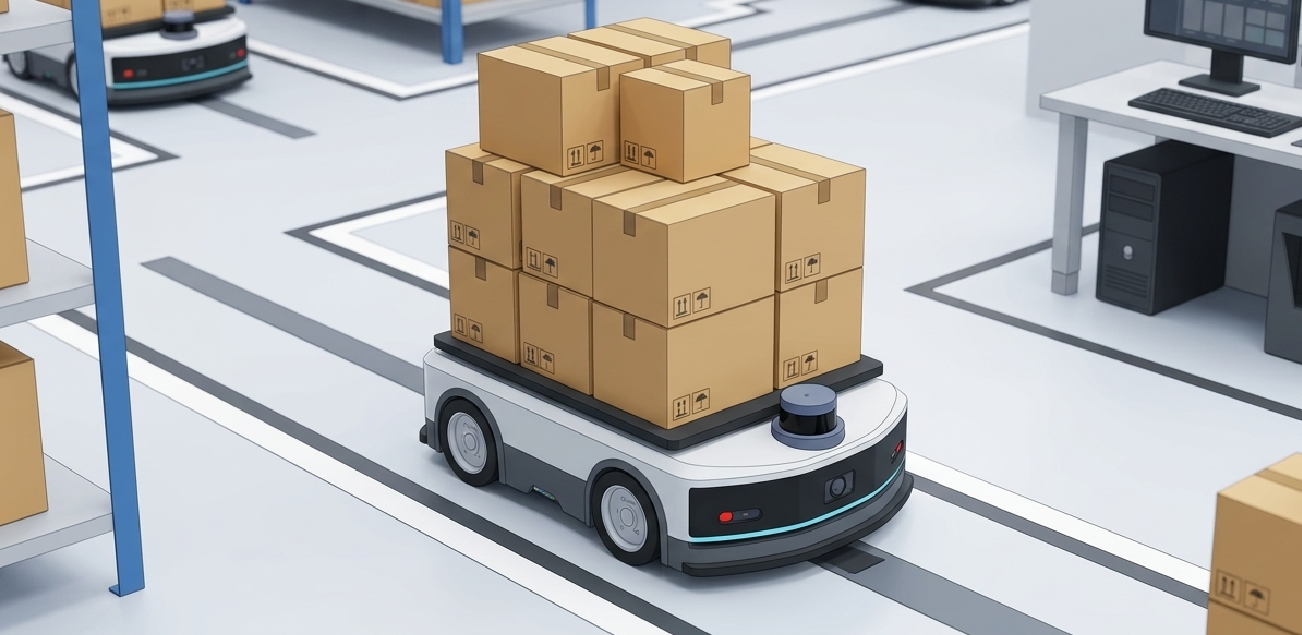
If you're evaluating autonomous robots for a warehouse or manufacturing facility in Pakistan, you will quickly encounter two terms: AMR (Autonomous Mobile Robot) and AGV (Automated Guided Vehicle). They sound similar. They both move goods around a facility without a human driver. But they are fundamentally different technologies — and choosing the wrong one for your facility can cost you significantly in both money and disruption.
This guide breaks down the real difference, what each one costs, and which makes more sense for the industrial realities of Pakistani facilities.
An Automated Guided Vehicle (AGV) follows a fixed, pre-defined path through a facility. That path is typically defined by physical infrastructure: magnetic tape on the floor, embedded wire guides, reflective markers, or laser targets mounted on walls. The robot follows the path reliably — but it cannot deviate from it.
AGVs have been used in large-scale manufacturing since the 1950s. They are highly reliable for fixed, repetitive routes in controlled environments — automotive assembly lines, dedicated pallet conveyors, fixed inbound logistics routes.
The core limitation: any change to the facility layout requires physical modification of the guide infrastructure. A new shelf position, a blocked aisle, or a moved charging station requires re-taping the floor or reconfiguring markers. In Pakistan's dynamic industrial environments, where layout changes are frequent and floor conditions are variable, this is a significant constraint.
An Autonomous Mobile Robot (AMR) navigates freely using onboard sensors, SLAM algorithms, and real-time environmental mapping. It builds and continuously updates a map of its environment — no floor tape, no markers, no fixed infrastructure required.
AMRs can avoid obstacles dynamically, reroute around a forklift, adapt to a new shelf configuration, and operate safely alongside human workers. When the environment changes, the robot adapts — rather than stopping and waiting for an engineer to modify its guide path.
This flexibility is what makes AMRs the preferred choice for modern warehousing and distribution operations globally — and specifically for the brownfield facilities that make up the majority of Pakistan's industrial stock.
Flexibility: AGVs follow fixed paths. AMRs navigate dynamically and adapt to changes in real time.
Infrastructure requirement: AGVs require physical floor modifications (tape, wire, markers). AMRs require none — they work on existing floors as-is.
Obstacle handling: AGVs typically stop when encountering an unexpected obstacle and wait for it to be cleared. AMRs intelligently reroute around obstacles.
Deployment time: AGVs require more upfront installation time to set up guide infrastructure. AMRs can be deployed and operational faster once their facility map is built.
Cost: AGVs are generally lower unit cost for simple fixed routes. AMRs have higher unit cost but lower infrastructure cost and much greater operational flexibility.
Scalability: Adding AMRs to a fleet is straightforward — each robot maps the environment independently. Scaling AGVs requires extending the guide infrastructure.
For most Pakistani industrial facilities — warehouse godowns in Karachi, pharmaceutical distribution centres in Lahore, FMCG hubs in Islamabad — AMRs are the better choice for several reasons:
First, most facilities were not built for robotics. There is no pre-existing guide infrastructure, and installing it would require significant floor disruption to live operations. AMRs need none of this.
Second, Pakistani industrial floors change frequently. Seasonal inventory reconfigurations, new SKU introductions, Ramadan and Eid volume spikes — all create dynamic environments where fixed-path AGVs struggle.
Third, AMRs work safely alongside human workers — important in facilities where full automation is not the goal, and where human-robot collaboration is the realistic near-term model.
At Helpforce AI, we deploy AMRs using a simulation-first methodology. Before any hardware arrives at your facility, we build a digital twin of your floor plan in NVIDIA Isaac Sim — validating robot paths, testing edge cases, and confirming performance against your specific SKU density, aisle widths, and shift patterns.
The robot that arrives at your facility already knows your building. That's the difference between a deployment that works from Day 1 and one that costs three months of troubleshooting.
We deploy across Pakistan — Karachi, Lahore, Faisalabad, Islamabad, and beyond. Talk to us about your facility.