
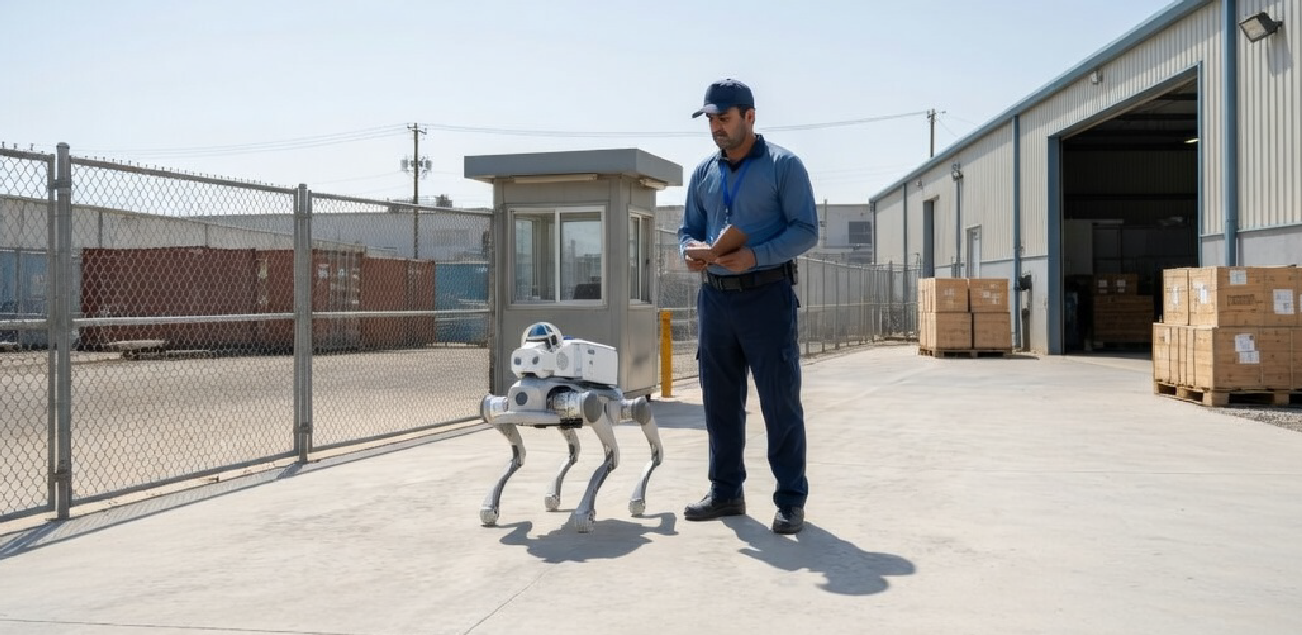
This article does something most robotics vendors avoid: it gives you the actual numbers. A direct cost comparison between human security guards and autonomous security robots in the Pakistani market — so you can make an informed decision based on real arithmetic, not a sales pitch.
Most Pakistani businesses dramatically underestimate their true security cost because they only count salary. Let's look at the full picture for a typical 3-guard overnight security setup at a medium-sized industrial facility in Karachi or Lahore.
Per guard monthly cost:
Basic salary: PKR 35,000–45,000. EOBI contribution (employer): PKR 1,200. SESSI/PESSI health contribution: PKR 1,500–2,000. Uniform and equipment allowance: PKR 1,500. Overtime (realistic for 12-hour shifts): PKR 8,000–15,000. Annual bonus amortised monthly: PKR 3,000–4,000.
Realistic fully-loaded monthly cost per guard: PKR 50,000–67,000.
For a 3-guard overnight setup: PKR 150,000–200,000 per month, or PKR 1.8–2.4 million annually. That's before factoring in turnover cost — replacing a security guard typically costs 1–2 months' salary in recruitment, vetting, and retraining. Pakistani industrial businesses with high guard turnover can add another PKR 200,000–400,000 annually to this number.
Three guards working overnight shifts are human. They fatigue. Attention drops sharply after 2–3am. They can be distracted, bribed, or simply miss things in large facilities with multiple blind spots. Incident logs are manual and inconsistent. Coverage gaps during prayer times, toilet breaks, and shift handovers are real.
This is not a criticism of guards as individuals — it is a structural limitation of human attention over long overnight shifts in large, monotonous environments.
A single autonomous security robot with LiDAR navigation, thermal imaging, real-time alert capability, and remote monitoring integration has an approximate landed cost in Pakistan of USD 25,000–45,000 (PKR 7–12.5 million at current rates), including import duty and logistics.
Amortised over a 5-year operational lifespan: PKR 140,000–210,000 per month. Add annual maintenance of approximately 12% of hardware cost: PKR 14,000–25,000 per month.
Total monthly cost: PKR 154,000–235,000.
At first glance, this looks similar to or slightly higher than three human guards. But that comparison is not the right one.
One security robot provides: continuous 24/7 patrol with zero fatigue degradation, 360-degree LiDAR awareness that humans cannot match, thermal imaging that detects intruders in complete darkness, timestamped incident logs that are admissible as evidence, real-time remote monitoring access for management, and consistent patrol routes that don't have gaps.
It never needs a break. It doesn't check its phone. It cannot be bribed. It generates a complete, auditable record of every patrol.
For facilities where overnight shrinkage, perimeter breaches, or asset protection are real concerns, the comparison isn't just cost — it's capability.
Helpforce AI doesn't recommend replacing all human security with robots. The optimal model for most Pakistani industrial facilities is hybrid: one or two autonomous robots handling patrol coverage and monitoring, with human guards focused on access control, response, and judgement-based tasks.
This typically reduces guard headcount by 40–60% while increasing overall coverage quality. The maths work. And more importantly, the security outcome improves.
Helpforce AI will scope a security robotics deployment for your specific facility and give you a clear cost comparison against your current security arrangement. No obligation. Pakistan-based team. Contact us.