
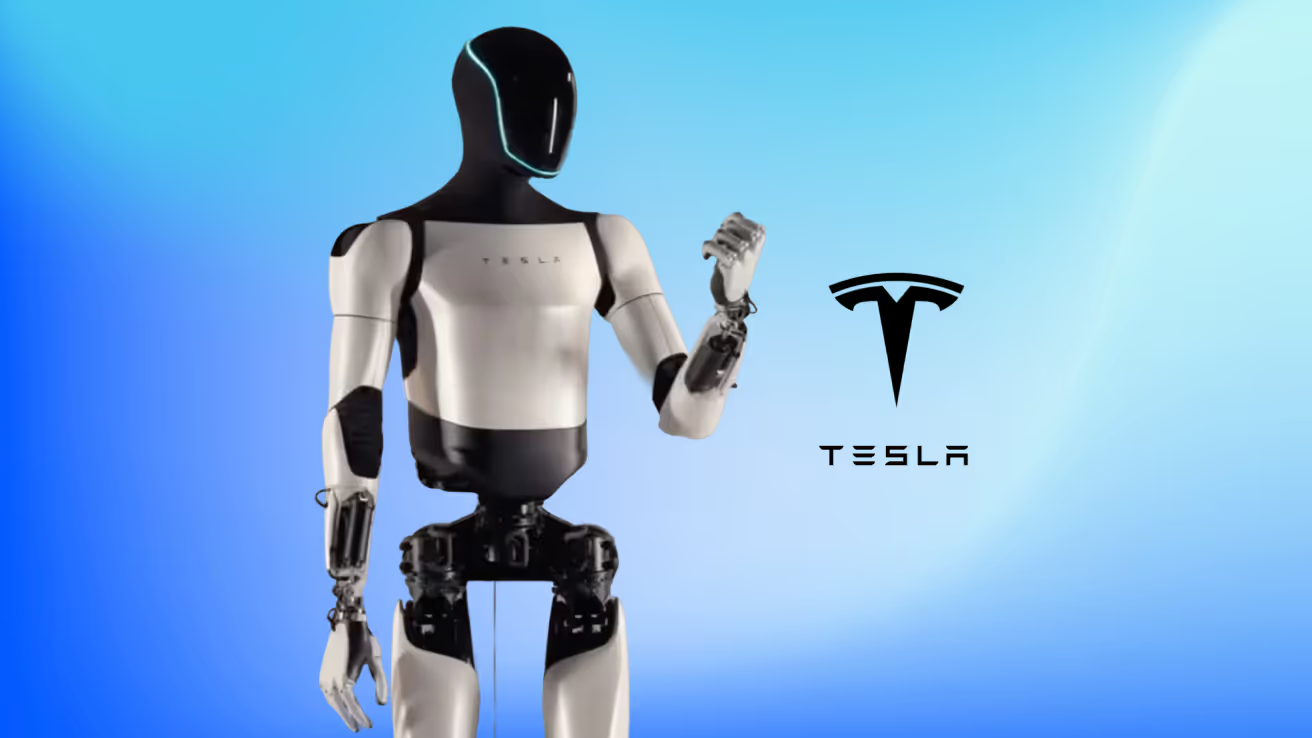
The future of humanoid robotics is taking physical form in Texas and California. In Q1 2026, Tesla confirmed it is converting its Fremont factory — where the Model S and Model X were built — into the world's first large-scale Optimus humanoid robot production line. Production is expected to begin in late July or August 2026. Simultaneously, Tesla is breaking ground on a second-generation factory at Gigafactory Texas, targeting a long-term annual production capacity of 10 million robots per year.
Tesla has laid out a clear production ramp for Optimus across two facilities. The Fremont plant — converted from Model S/X production — is designed for a first-generation production capacity of 1 million units per year, with mass production beginning by end of 2026. The Giga Texas facility represents the larger ambition: a second-generation production line with a long-term designed annual capacity of 10 million robots. Site preparation is already underway in Texas, with production expected to begin in summer 2027.
For context, 10 million units annually requires producing approximately 27,000 robots per day. The entire global industrial robot market currently ships around 500,000 units annually. Tesla's target would represent a 20x increase in total global robot production volume.
Elon Musk has stated a target manufacturing cost of $20,000 per unit at scale, with consumer pricing expected below $25,000 once volume production is established.
The version entering production is Optimus Gen 3, featuring 37 joints — nine more than the previous generation — with harmonic and planetary drive systems enabling walking speeds of up to 1.2 meters per second and stable operation on 15-degree slopes. The Gen 3 hands feature 50 actuators total, a 4.5x increase in dexterity from Gen 2. The robot is powered by Tesla's AI5 inference chip — the same chip being deployed to Tesla supercomputers — delivering approximately 5x the compute of AI4.
Current Optimus Gen 2 robots are performing real production tasks inside Tesla's Fremont and Austin factories: battery cell sorting, parts handling, and quality inspection.
Tesla's Optimus is a general-purpose humanoid robot designed to perform tasks currently done by humans. Unlike industrial robots that excel at specific, repetitive tasks in controlled environments, Optimus is designed as a general-purpose platform capable of learning and performing diverse tasks across varied environments.
Manufacturing Expertise: Tesla has proven it can scale production of complex electromechanical products to millions of units annually with improving quality and declining costs.
Vertical Integration: Tesla manufactures many components in-house, providing greater control over cost, quality, and scaling.
AI Capabilities: Optimus benefits from Tesla's investment in AI for autonomous driving — computer vision, path planning, and decision-making.
Battery Technology: Tesla's battery expertise translates directly to Optimus power systems.
The AI5 Chip: Tesla's in-house AI inference processor is deploying to Optimus first — before vehicles — giving the robot a compute advantage over hardware-dependent competitors.
May 2026: Final Model S and Model X vehicles produced at Fremont. Production line dismantled.
July to August 2026: Optimus production begins at Fremont. Output initially slow given 10,000 unique parts across an entirely new production line.
End of 2026: Mass production targets activated at Fremont with 1 million unit annual capacity.
Summer 2027: Giga Texas second-generation Optimus facility begins production.
2027 onwards: External sales to enterprise customers. Consumer availability targeted for end of 2027.
The potential applications for capable, affordable humanoid robots span manufacturing, logistics, retail, healthcare, construction, hospitality, agriculture, and domestic settings. Musk has suggested a target price around $20,000 to $30,000 for Optimus — comparable to a mid-range vehicle. At that price, the economic case becomes compelling for applications where human labor costs $30,000 to $50,000 annually plus benefits.
Despite Tesla's advantages, significant challenges remain. General-purpose humanoid robotics is extraordinarily complex. Safety regulations for robots operating alongside humans are still evolving in most jurisdictions. Competition from Boston Dynamics, Figure AI, and Chinese manufacturers including Unitree is accelerating. Early production will face the same ramp challenges Tesla encountered with Model 3 and Cybertruck.
The production target of 10 million units is a long-term design capacity, not a near-term forecast. Musk himself stated it is "literally impossible to predict" the production rate in 2026. The honest read: production starts this year, meaningful volume comes in 2027, scale comes later.