
The phrase digital twin has become one of the most overused terms in industrial technology. Consultants use it loosely. Vendors apply it to almost anything. The result is that many Pakistani manufacturing and logistics operators either dismiss it as hype or misunderstand what it actually means for real deployments.
This article explains what a digital twin genuinely is, how it's actually used in robotics deployment, and why it matters specifically for Pakistani industrial facilities.
A digital twin is a high-fidelity virtual replica of a physical environment — updated with real data and accurate enough to simulate real-world behaviour with meaningful precision.
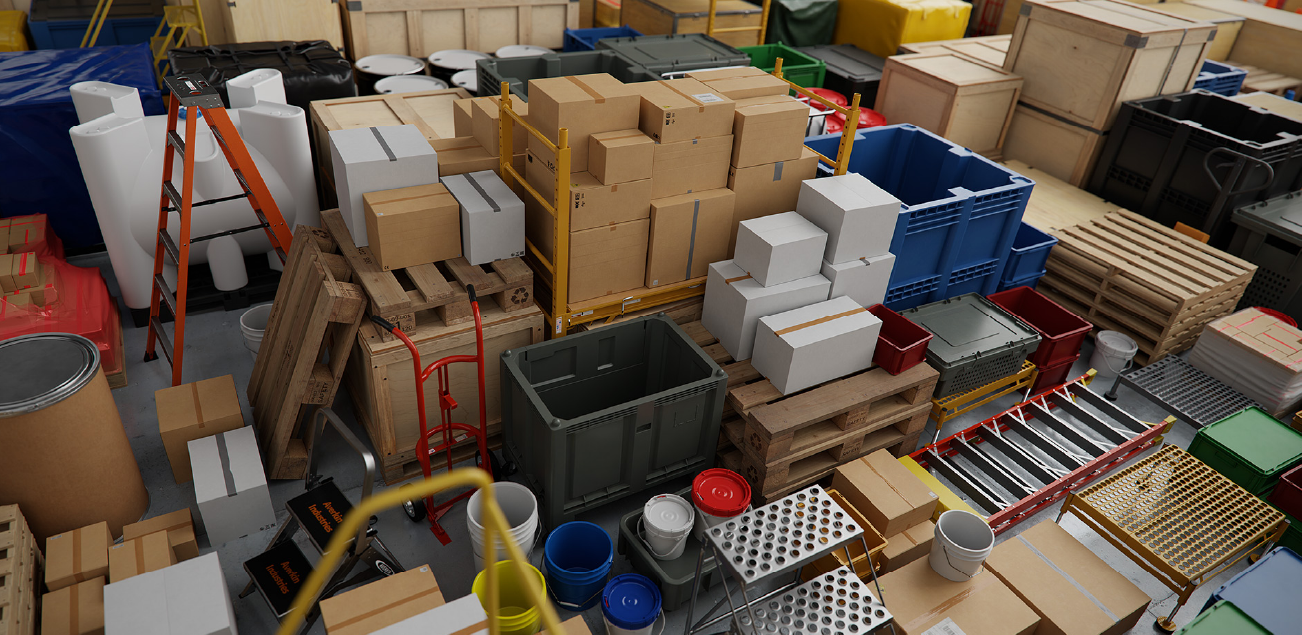
In the context of industrial robotics, a digital twin means a three-dimensional model of your facility — your exact floor plan, aisle dimensions, shelf heights, door positions, lighting conditions, equipment footprints — inside a physics simulation engine. Robots can be trained and tested in this virtual environment before any physical hardware is deployed.
The crucial word is fidelity. A rough sketch of a warehouse is not a digital twin. A CAD floor plan is not a digital twin. A high-fidelity physics simulation that accurately models how a robot will navigate around a specific shelf configuration at 3am with a forklift parked in aisle 7 — that is a digital twin.
NVIDIA Isaac Sim is the world's leading robotics simulation platform, built on NVIDIA's Omniverse engine. It creates photorealistic, physically accurate digital twins of real environments and allows robots to be trained, tested, and validated inside those environments before deployment.
Isaac Sim models real physics — friction, weight, sensor behaviour, lighting effects on cameras and LiDAR, collision dynamics. A robot trained in Isaac Sim learns real-world behaviour, not simplified approximations. This is why global robotics deployments — from BMW's factories to Amazon's warehouses — use Isaac Sim as their pre-deployment validation environment.
It is also what Helpforce AI uses for every deployment in Pakistan.
In markets with mature robotics ecosystems — Germany, Japan, South Korea — robots are often deployed into purpose-built facilities designed from the ground up for automation. The facility conforms to the robot.
Pakistan's industrial facilities are almost entirely the opposite. They are brownfield environments — existing buildings not designed for robotics, with irregular floor plans, varying ceiling heights, informal storage arrangements, and layouts that change frequently.
Deploying a robot into a brownfield Pakistani facility without a digital twin is a gamble. You discover the problems — the narrow aisle that the robot can't navigate, the shelf that blocks a critical sensor, the charging dock position that creates a traffic conflict — after the hardware has arrived and your production line is depending on it.
A digital twin reveals all of these problems in simulation, before hardware is ordered. That is the entire point.
Our process starts with site data collection — floor plan drawings, measurements, photographs, and where available, point cloud scanning data from the facility. We build this into a high-fidelity Isaac Sim environment, modelling not just the static structure but the dynamic elements: typical obstacle positions, worker movement patterns, lighting conditions at different times of day.
We then run the robot in this virtual environment across thousands of scenarios — testing performance, identifying failure points, and optimising configuration — before a single piece of hardware ships to your site.
When the robot arrives, your team is not watching it discover your building for the first time. It already knows it.
Digital twin validation reduces deployment risk, compresses integration timelines, and eliminates the most expensive category of robotics project failure: discovering fundamental incompatibilities after the hardware is on site. For Pakistani operators making their first automation investment, this risk reduction is not a luxury — it is how you ensure the investment delivers.
Contact Helpforce AI to discuss digital twin development for your facility. We're Pakistan-registered, Islamabad-based, and we build twins for facilities of all sizes across the country.