
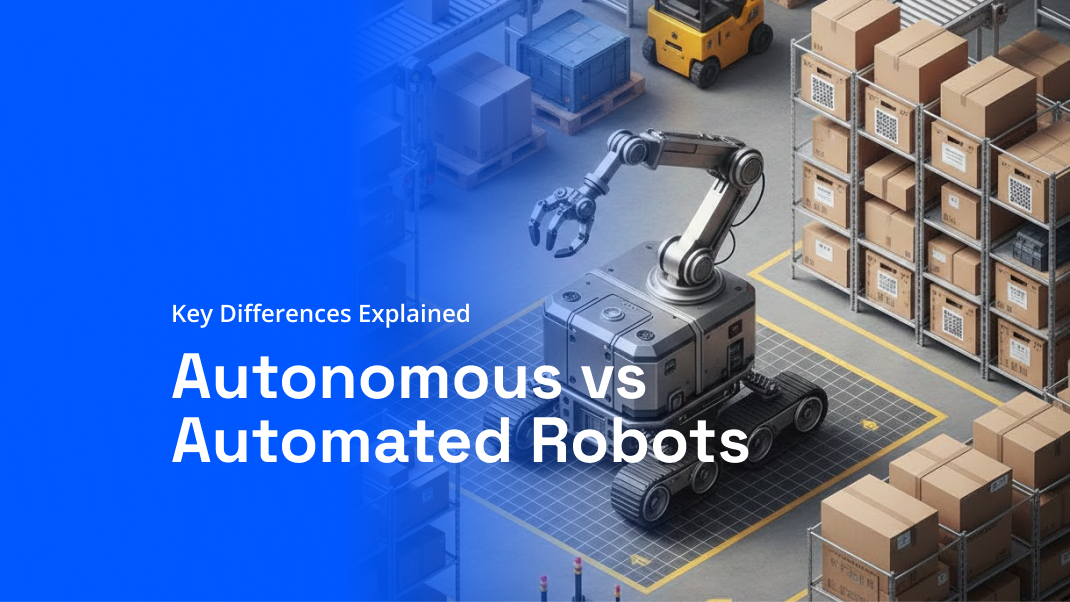
The difference between autonomous and automated robots is fundamental yet frequently misunderstood:
Automated Robots execute pre-programmed sequences exactly as programmed, follow fixed instructions without deviation, require human decision-making upfront (encoded in programming), operate predictably in controlled environments, and cannot adapt to unexpected situations.
Autonomous Robots make independent decisions based on sensor input, adapt behavior to changing conditions, learn from experience and improve over time, handle unexpected situations without human intervention, and operate effectively in unstructured, dynamic environments.
Think of it this way: an automated robot is like a player piano—executing pre-recorded instructions perfectly but incapable of improvisation. An autonomous robot is like a jazz musician—following general frameworks but adapting creatively to circumstances.
Automated Example - Assembly Line Robot: A traditional industrial robot welding car frames follows precise programmed movements: move arm to position A, activate welder for 3 seconds, move to position B, repeat. If a part is misaligned or an obstacle appears, the robot cannot adapt—it either completes the programmed sequence (potentially causing damage) or triggers an error and stops.
Autonomous Example - Warehouse Robot: An Amazon warehouse robot navigating between storage and packing stations makes continuous independent decisions: detecting people and avoiding them, choosing optimal paths around obstacles, adjusting for traffic congestion, recognizing when charging is needed, and handling unexpected blocked routes.
The warehouse robot possesses genuine autonomy—making real-time decisions based on sensory input without human guidance for each action.
This technological gap explains why autonomous robots are more expensive, complex, and challenging to develop—but dramatically more capable in real-world applications.
Autonomy exists on a spectrum rather than as binary state:
Level 0 - No Autonomy: Purely automated, following fixed programs. Example: Traditional industrial robots.
Level 1 - Assisted Autonomy: Robot handles specific tasks autonomously but requires human input for decisions. Example: Robots that navigate autonomously but need humans to identify what to pick.
Level 2 - Conditional Autonomy: Robot operates autonomously in expected situations, requests human help for exceptions. Example: Many current security patrol robots.
Level 3 - High Autonomy: Robot handles most situations independently, including unexpected events. Example: Advanced autonomous vehicles, sophisticated warehouse robots.
Level 4 - Full Autonomy: Robot operates completely independently in its operational domain. Example: Future vision for many robotics applications, few current systems achieve this.
Most commercial robots today operate at Levels 1-3, with research pushing toward Level 4.
Example Applications: Assembly line manufacturing, pick-and-place operations, welding and painting, CNC machining.
Example Applications: Warehouse logistics, security patrol, delivery services, agriculture, healthcare assistance.
Automated robots are generally less expensive: $50,000-$200,000 for industrial robots, lower operational costs (simple maintenance), predictable lifecycle costs, but require structured environments (potentially expensive facility modifications).
Autonomous robots command higher prices: $100,000-$500,000+ depending on capabilities, higher operational costs (sophisticated maintenance, software updates), potentially lower total cost of ownership through flexibility (operating in existing environments without modification).
The ROI calculation depends heavily on application specifics—autonomous robots' flexibility may justify higher upfront costs in dynamic environments.
Automated and autonomous robots require fundamentally different safety approaches:
Automated Robot Safety: Physical barriers separating robots from humans, light curtains and safety mats triggering emergency stops, lockout/tagout procedures for maintenance, and predictable hazard zones based on programmed movements.
Autonomous Robot Safety: Sensors detecting and avoiding humans dynamically, force-limiting preventing injury during accidental contact, redundant decision-making systems, continuous risk assessment adapting to situations, and sophisticated testing validating safety across countless scenarios.
Autonomous robots working alongside humans require far more sophisticated safety systems—but enable collaboration impossible with automated systems confined behind safety cages.
For UAE and Saudi Arabia's ambitious automation initiatives, understanding this distinction is strategic:
NEOM and Smart Cities: Require autonomous robots adapting to dynamic urban environments, handling unstructured public spaces, and collaborating with humans—automation alone is insufficient.
Industrial Facilities: Often suit automated robots for structured manufacturing, but autonomous robots enable flexible production adapting to changing product designs.
Logistics and Warehouses: Increasingly require autonomous robots handling variety and adapting to demand fluctuations that overwhelm fixed automation.
The robotics industry trend is clear: autonomy increasing across applications. Factors driving this include AI advances making autonomy more capable and reliable, cost reductions making autonomous systems economically viable, safety systems enabling confident human-robot collaboration, user expectations demanding flexibility automation cannot provide, and competitive pressure favoring adaptable systems.
Even traditional industrial robotics is incorporating autonomous features—collaborative robots (cobots) sensing and responding to human presence, vision systems adapting to part variations, and machine learning optimizing performance over time.
Understanding autonomous versus automated robots is fundamental for anyone evaluating robotics solutions. Automated robots excel at repetitive tasks in controlled environments—delivering speed, precision, and cost-effectiveness. Autonomous robots thrive in dynamic, unstructured environments—providing flexibility, adaptability, and human collaboration capabilities.
The right choice depends on your specific application, environment, and requirements. Many organizations use both—automation for structured manufacturing processes, autonomy for logistics, maintenance, and human-facing applications.
As robotics technology advances, autonomy will increasingly become the default for new deployments. Organizations understanding this distinction and selecting appropriately will maximize their robotics investments and competitive advantages.