
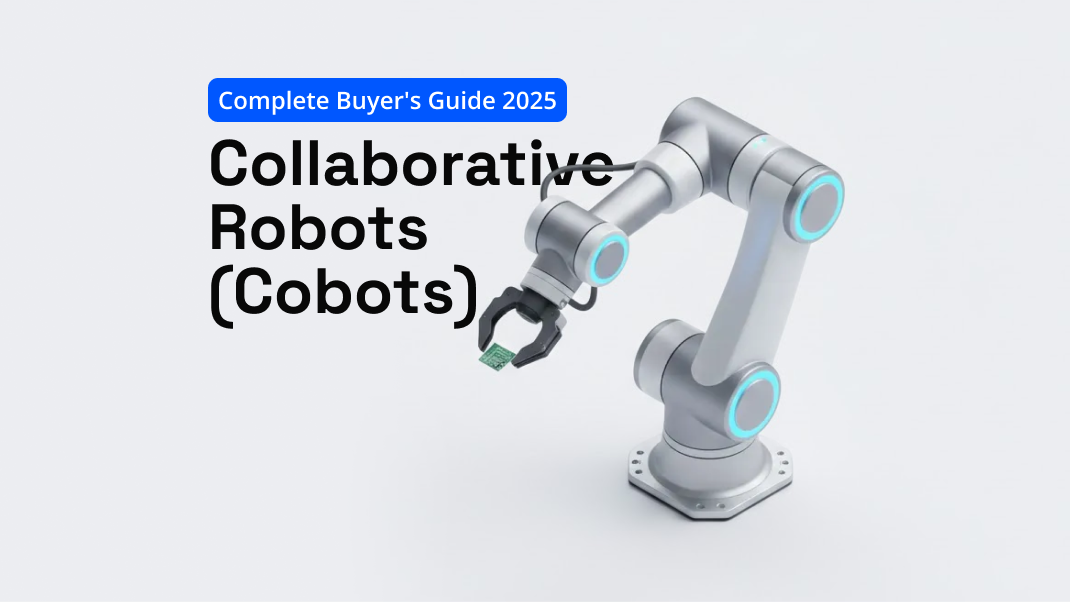
Collaborative robots—cobots—represent the fastest-growing robotics segment, with the global market projected to reach $12.3 billion by 2030. Unlike traditional industrial robots confined behind safety cages, cobots work safely alongside humans, transforming manufacturing flexibility and accessibility. This comprehensive guide helps you evaluate whether cobots suit your needs and how to select the right solution.
Collaborative robots (cobots) are robotic systems designed to work directly with human operators in shared workspaces without physical barriers. Key distinguishing features include built-in safety systems (force limiting, collision detection), easy programming (often teach-by-demonstration), lightweight design (typically 10-50kg), flexible deployment (mounted on benches, mobile bases, or overhead), and lower cost than traditional industrial robots ($20,000-$75,000 vs $50,000-$200,000+).
The "collaborative" designation doesn't just mean "safe"—it means fundamentally designed for human-robot teamwork rather than replacing humans entirely.
Understanding the distinction helps determine which approach suits your application:
Traditional Industrial Robots: High payload capacity (hundreds to thousands of kg), fast operation speeds, high precision and repeatability, require safety caging and barriers, complex programming requiring specialists, permanent installation, expensive ($50,000-$200,000+), ideal for high-volume repetitive tasks.
Collaborative Robots (Cobots): Lower payload capacity (typically 3-35kg), slower speeds prioritizing safety, adequate precision for most tasks, operate safely without barriers, intuitive programming (teach-by-demonstration), easily repositioned/redeployed, more affordable ($20,000-$75,000), ideal for varied tasks and small batch production.
The right choice depends on your specific requirements—high-volume identical parts favor traditional robots, while varied tasks and frequent changeovers favor cobots.
Cobots achieve safety through multiple integrated systems:
1. Force and Power Limiting: Sensors continuously monitor forces exerted, automatic stopping when unexpected resistance detected (contact with human), adjustable force thresholds for different applications, and compliance making cobots yield when pushed.
2. Collision Detection: Real-time monitoring of motor currents, detecting anomalies indicating collisions, immediate stopping within milliseconds, and preventing injury even if contact occurs.
3. Speed Limiting: Maximum speeds typically 250-1500mm/s (much slower than traditional robots), reduced speed when humans are nearby (using presence detection), and configurable speed zones.
4. Rounded Design: Smooth surfaces without pinch points, soft materials on contact areas, and elimination of sharp edges.
5. Emergency Stops: Multiple accessible e-stop buttons, both on robot and control interfaces, and immediate power cutoff capability.
These features enable cobots to work alongside humans without safety cages—the defining collaborative capability.
The market leader with ~50% market share. Models include:
Strengths: Largest ecosystem of compatible accessories, extensive support network, proven reliability, intuitive programming interface.
YuMi (500g payload each arm): $40,000-$55,000 - Dual-arm for small parts assembly, electronicsGoFa (5kg payload): $35,000-$45,000 - General purpose collaborativeSWIFTI (4kg payload): $30,000-$40,000 - High-speed pick-and-place
Strengths: Industrial robot heritage, strong support, good for electronics assembly.
CR-4iA (4kg payload): $30,000-$40,000 - Cleanroom compatible, food-safeCR-7iA (7kg payload): $35,000-$45,000 - Machine tending, packagingCR-15iA (15kg payload): $45,000-$60,000 - Heavier applications
Strengths: Industrial reliability, cleanroom/food-safe options, extensive dealer network.
TM5 (4-14kg models): $20,000-$35,000 - Budget-friendly, built-in visionTM12 (12kg payload): $28,000-$38,000 - Mid-range applicationsTM14 (14kg payload): $30,000-$40,000 - Heavier tasks
Strengths: Built-in vision system, competitive pricing, good for Asian markets.
LBR iiwa (7-14kg): $60,000-$80,000 - High sensitivity, medical/research applicationsLBR iisy (3-11kg): $35,000-$50,000 - More affordable line
Strengths: Highest sensitivity (ideal for medical, research), German engineering quality.
M0609 (6kg payload): $25,000-$35,000 - Compact, affordableM1013 (10kg payload): $30,000-$40,000 - Mid-range workhorseH2017 (20kg payload): $45,000-$60,000 - Heavy-duty collaborative
Strengths: Competitive pricing, good payload-to-cost ratio, growing market presence.
Machine Tending: Loading/unloading CNC machines, injection molding, stamping presses. ROI: 12-24 months through increased machine utilization.
Pick and Place: Moving parts between conveyors, sorting, packaging. ROI: 8-18 months through labor savings and consistency.
Assembly: Screwing, fastening, pressing components together. ROI: 15-30 months through quality improvement and labor reduction.
Quality Inspection: Using vision systems for defect detection, dimensional verification. ROI: 18-36 months through reduced defects and rework.
Packaging and Palletizing: Boxing products, stacking on pallets. ROI: 10-20 months through increased throughput.
Welding: Consistent weld quality for small production runs. ROI: 20-36 months through quality improvement.
Polishing and Grinding: Consistent surface finishing. ROI: 18-30 months through quality and labor savings.
Material Handling: Moving parts within facilities, inventory management. ROI: 15-25 months through productivity gains.
Cobot ROI calculation should consider multiple factors:
Costs: Cobot purchase ($20,000-$75,000), end-effector/gripper ($2,000-$15,000), accessories (sensors, vision, $5,000-$20,000), integration and setup ($5,000-$30,000), training ($2,000-$5,000), maintenance ($1,000-$3,000 annually).
Total Initial Investment: Typically $35,000-$150,000 depending on complexity.
Benefits: Labor cost savings (1-3 FTE equivalents at $35,000-$50,000 each), increased throughput (20-40% typical), quality improvement (30-60% defect reduction), reduced scrap and rework, employee safety improvement, flexibility enabling new capabilities.
Typical ROI: 12-36 months for most applications, faster for high-labor-cost operations, slower for complex implementations.
Real Example: A medical device manufacturer deployed a UR10e cobot for assembly ($75,000 total investment). Results: replaced 1.5 FTE ($82,500 annual cost), increased throughput 35% ($45,000 value), reduced defects 45% ($18,000 saving). Total annual benefit: $145,500. ROI: 6.2 months.
Cobot programming is dramatically simpler than traditional robots:
Teach-by-Demonstration: Physically guide the robot through desired motions, record waypoints by moving robot, intuitive for non-programmers.
Graphical Programming: Drag-and-drop interfaces, pre-built function blocks (move, grip, release), visual flow diagrams, no coding experience required.
Script Programming: For advanced users, Python, URScript, or manufacturer-specific languages, greater flexibility and sophistication.
Templates and Wizards: Pre-configured programs for common tasks (palletizing, machine tending), customizable parameters, faster deployment.
Most users can program basic cobot tasks in hours, not weeks—a transformative advantage over traditional robots.
Cobots' lightweight, portable nature enables flexible deployment:
Bench Mounting: Bolted to workbenches or tables, stable for precision tasks, easily relocated.
Mobile Bases: Autonomous mobile robots (AMRs) with mounted cobots, move between workstations autonomously, ultimate flexibility.
Overhead Mounting: Ceiling or overhead structure mounting, saves floor space, useful for reaching multiple work areas.
Collaborative Workstations: Shared human-robot workspaces, humans handle complex tasks, robots handle repetitive components.
This flexibility enables single cobot to serve multiple applications—morning assembly, afternoon quality inspection, overnight machine tending.
Modern cobots integrate readily with:
Machine Tools: CNC machines, injection molding, stamping presses via direct communication protocols.
Vision Systems: 2D cameras for part recognition, 3D vision for bin picking, integrated with robot control.
Conveyors: Tracking systems for moving objects, picking/placing on moving conveyors.
PLCs and Controllers: Standard industrial communication (Ethernet/IP, Modbus, Profinet).
Quality Systems: Data logging for traceability, statistical process control integration.
ERP/MES: Production data reporting, scheduling integration.
Most cobot manufacturers provide integration kits and support for common systems, simplifying deployment.
Cobots aren't perfect for every application:
Speed: Slower than traditional robots (safety requirement). Not ideal for extremely high-speed applications.
Payload: Limited to ~35kg maximum. Heavy applications require traditional robots.
Precision: Adequate for most tasks but lower than high-end traditional robots. Ultra-precision applications may need traditional.
Cycle Time: Slower speeds mean longer cycle times. High-volume identical parts may favor traditional robots.
Safety Certification: Shared workspaces require safety assessments. Complex regulations in some industries/regions.
Understanding these limitations helps set realistic expectations and select appropriate applications.
UAE and Saudi Arabia represent excellent cobot markets:
SME Manufacturing Growth: Vision 2030 and economic diversification drive SME manufacturing—ideal cobot customers.
Labor Market Dynamics: High labor costs and workforce nationalization goals make automation attractive.
Flexible Manufacturing: Regional manufacturers need flexibility for varying products and small batches—cobot strength.
Technology Adoption: Government support for advanced manufacturing accelerates cobot adoption.
New Facilities: Modern facility construction enables cobot-friendly designs from inception.
Skills Development: Cobot ease-of-use supports workforce training and technology transfer goals.
Choosing the right cobot and supplier involves multiple factors:
Technical Requirements: Payload capacity, reach, precision, speed, environment (cleanroom, food-safe, etc.).
Budget: Purchase cost, total cost of ownership, financing options.
Ease of Use: Programming interface, learning curve, available training.
Ecosystem: Available end-effectors and accessories, third-party integration support.
Support: Local service and support, spare parts availability, technical expertise, training programs.
Vendor Stability: Financial health, market presence, customer base, upgrade path and product roadmap.
Proof of Concept: Many vendors offer trial periods or demonstrations—valuable for validating fit before purchase.
Cobot technology continues advancing:
AI Integration: Computer vision for part recognition, machine learning for optimization, adaptive behaviors.
Increased Payloads: New models handling 50kg+ while maintaining collaborative safety.
Better Mobility: More AMR-mounted cobots, easier redeployment, autonomous movement between tasks.
Improved Interfaces: Augmented reality programming, voice control, gesture recognition.
Lower Costs: Economies of scale reducing prices, increasing accessibility for smaller businesses.
Standardization: Industry standards improving interoperability, easier integration across vendors.
Collaborative robots represent a democratization of industrial automation—bringing robotic capabilities to companies and applications that traditional robots couldn't serve economically or practically. Their safety, ease of use, flexibility, and affordability are transforming manufacturing worldwide.
For organizations in the Middle East pursuing operational excellence and economic diversification, cobots offer proven technology delivering measurable results. Whether you're a large manufacturer optimizing processes or an SME exploring first automation, cobots provide accessible entry into the robotic revolution.
The question isn't whether cobots will transform your industry—it's when you'll deploy them and how quickly you'll realize their benefits.