
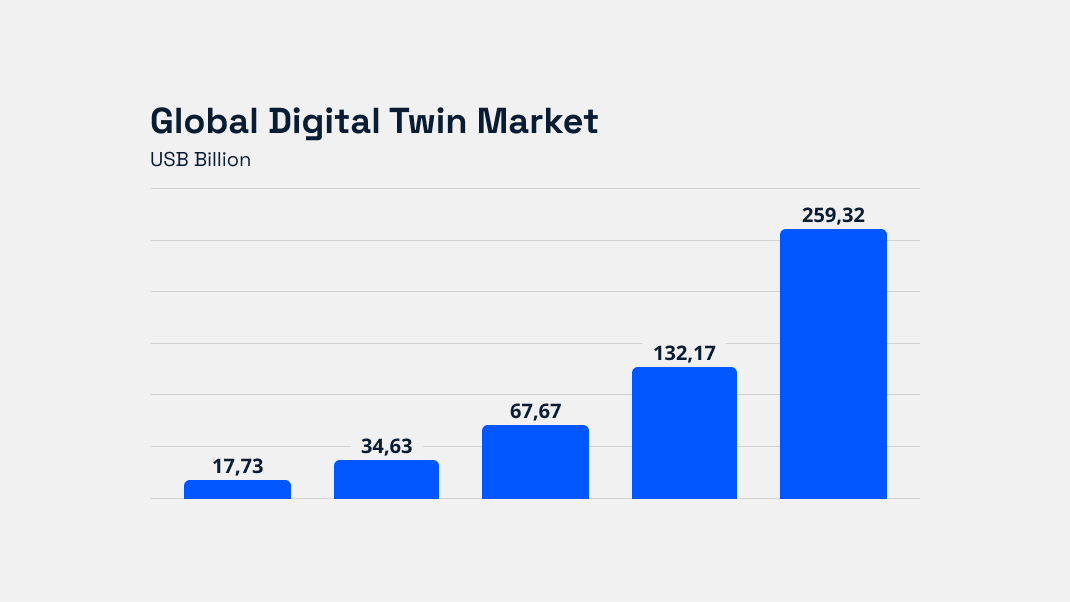
The digital twin revolution is accelerating at unprecedented pace, with the global market projected to surge from $17.73 billion in 2024 to a staggering $259.32 billion by 2032—representing a compound annual growth rate of 40.1%. This explosive growth signals a fundamental shift in how industries design, optimize, and operate everything from individual products to entire cities.
Understanding the Digital Twin Explosion
Digital twins—virtual replicas of physical assets, processes, or systems that mirror real-world behavior in real-time—have evolved from niche aerospace and automotive applications to mainstream adoption across virtually every industry. The technology's power lies in enabling organizations to simulate, predict, and optimize performance without the cost, risk, and time constraints of physical experimentation.
Market Leaders and Regional Dynamics
North America dominates the digital twin landscape with 38.35% market share, driven by massive technology investments, advanced manufacturing infrastructure, and early adoption by aerospace giants like Boeing and automotive leaders like Ford and General Motors. The region's leadership reflects decades of investment in simulation technologies and computational infrastructure.
However, Asia-Pacific is the fastest-growing region, propelled by China's smart manufacturing initiatives, Japan's industrial automation leadership, and India's burgeoning technology sector. The Middle East, particularly UAE and Saudi Arabia, is emerging as a significant market driven by smart city megaprojects and oil & gas digital transformation initiatives.
Healthcare: The Unexpected Leader
Perhaps most surprising is healthcare's emergence as the highest-growth segment, with an extraordinary 52.7% CAGR. Digital twins in healthcare enable personalized medicine through patient-specific organ and system models, surgical planning and rehearsal using patient digital twins, drug development acceleration via virtual clinical trials, hospital operations optimization, and medical device design and testing.
The COVID-19 pandemic accelerated healthcare digital twin adoption, demonstrating the technology's value for pandemic modeling, vaccine distribution optimization, and hospital capacity management. Post-pandemic, healthcare organizations continue investing heavily, recognizing digital twins as transformative for patient outcomes and operational efficiency.
Industry 4.0 and Manufacturing Transformation
Manufacturing remains the largest application domain, using digital twins for production line optimization, predictive maintenance, quality control, supply chain resilience, and new product development. Smart factories integrate digital twins at every level—individual machines, production lines, entire facilities, and global manufacturing networks.
The synergy between digital twins and Industry 4.0 initiatives drives unprecedented manufacturing efficiency. Companies report 20-40% reductions in downtime through predictive maintenance, 15-30% improvements in production efficiency through simulation-based optimization, 10-25% reductions in energy consumption, and 30-50% faster time-to-market for new products.
M&A Activity Signals Market Maturation
Major acquisitions demonstrate the market's strategic importance. Siemens' $10.6 billion acquisition of Altair (October 2025) created the world's most comprehensive AI-powered industrial software suite, combining simulation, high-performance computing, data analytics, and digital twins in a single integrated platform.
This mega-deal signals industry consolidation as technology giants recognize that competitive advantage increasingly depends on comprehensive digital twin capabilities. Expect continued M&A activity as companies race to build end-to-end digital twin solutions spanning design, simulation, deployment, and operation.
Smart Cities and Infrastructure
Smart city initiatives represent massive digital twin growth opportunities. Cities worldwide are creating urban digital twins that integrate building information modeling (BIM), traffic systems, utility networks, emergency services, environmental monitoring, and citizen services.
Singapore's Virtual Singapore project, Dubai's Smart Dubai initiative, and Saudi Arabia's NEOM megacity exemplify how digital twins enable city planners to simulate urban development scenarios, optimize transportation and utility systems, predict and manage environmental impacts, plan emergency response strategies, and engage citizens in urban planning.
Energy and Sustainability
The energy sector uses digital twins for power plant optimization, renewable energy forecasting (wind, solar), smart grid management, oil & gas exploration and production, and carbon footprint reduction. As global energy systems transition to renewables, digital twins become essential for managing complexity and ensuring reliability.
Digital twins enable energy companies to integrate variable renewable sources into grids designed for predictable fossil fuel generation, optimize battery storage deployment and operation, predict equipment failures before they cause outages, and reduce energy waste throughout distribution networks.
Challenges and Considerations
Despite explosive growth, digital twin adoption faces challenges including data integration complexity (connecting diverse systems), computational requirements (processing massive data streams in real-time), talent shortages (expertise in both domain knowledge and digital twin technologies), interoperability (connecting digital twins from different vendors), and data security and privacy concerns.
Organizations succeeding with digital twins address these challenges through strategic technology partnerships, phased implementation approaches, investment in training and talent development, adoption of open standards, and robust cybersecurity frameworks.
The Middle East Opportunity
For UAE and Saudi Arabia, digital twin technology aligns perfectly with national transformation visions. NEOM's ambition to be the world's most technologically advanced city depends fundamentally on comprehensive digital twin implementations. UAE's smart city initiatives in Dubai and Abu Dhabi increasingly rely on urban digital twins for planning and operations.
The region's oil & gas sector—traditional digital twin early adopters—continues advancing, while new sectors including renewable energy, logistics, healthcare, and manufacturing embrace the technology. Government support, available capital, and ambitious development timelines create ideal conditions for digital twin market leadership.
Looking to 2032
The path to $259 billion by 2032 will be driven by AI integration (machine learning enhancing digital twin predictive capabilities), edge computing (enabling real-time digital twins for mobile assets), 5G and IoT expansion (connecting billions of sensors feeding digital twins), sustainability focus (using digital twins to optimize energy and resources), and democratization (cloud-based platforms making digital twins accessible to smaller organizations).
Digital twins are transitioning from competitive advantage to competitive necessity. Organizations that master this technology will optimize operations, accelerate innovation, and make better decisions than competitors still relying on traditional approaches.
The digital twin revolution isn't coming—it's here. The question is whether your organization will lead this transformation or be disrupted by those who do.