
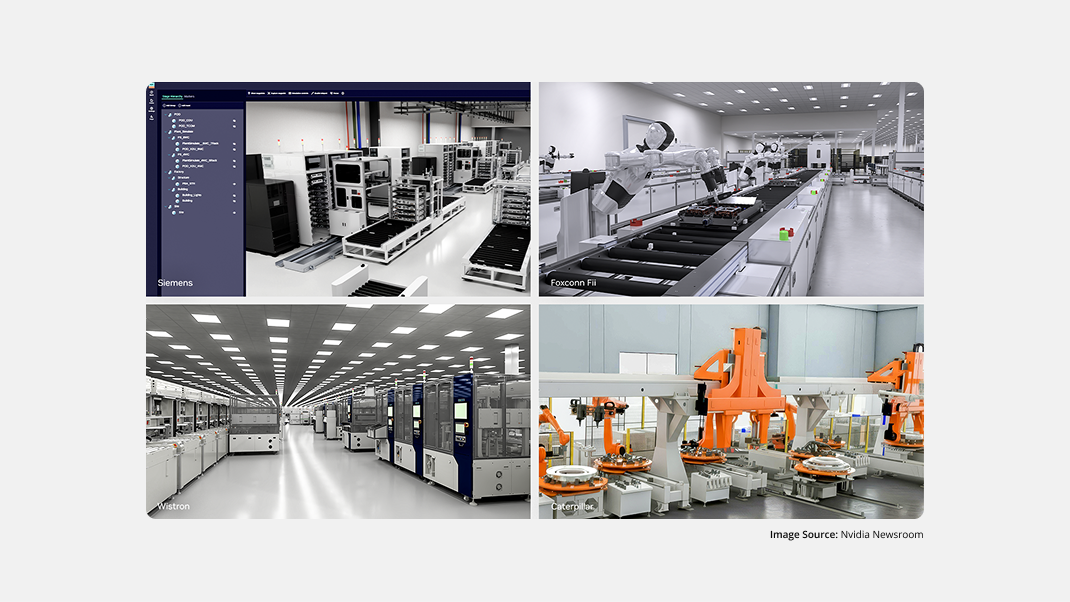
In a landmark announcement, NVIDIA revealed partnerships with America's manufacturing and robotics leaders to drive national reindustrialization through Physical AI, Omniverse digital twins, and collaborative robots. This initiative positions the United States at the forefront of the next industrial revolution, where AI-powered factories become intelligent, adaptive systems capable of competing globally.
The $1.2 Trillion Manufacturing Investment Wave
American manufacturing is experiencing unprecedented investment. In 2025 alone, $1.2 trillion in U.S. production capacity expansion was announced—led by electronics providers, pharmaceutical companies, and semiconductor manufacturers. This represents the largest domestic manufacturing investment since World War II.
However, building factories is only part of the challenge. Operating them competitively requires levels of automation, efficiency, and adaptability impossible with traditional approaches. This is where NVIDIA's Physical AI and digital twin technologies become game-changers.
What is Physical AI?
Physical AI represents the convergence of artificial intelligence with physical world interactions. Unlike software AI that operates purely in digital domains, Physical AI enables robots and autonomous systems to perceive physical environments, understand spatial relationships, make decisions about physical actions, execute those actions precisely, and learn from physical world feedback.
NVIDIA's Physical AI platform combines Isaac robotics simulation, Omniverse digital twin environment, Jetson edge AI computing, cuOpt logistics optimization, and pre-trained AI models (NIMs) for perception, grasping, manipulation, and navigation.
Omniverse: The Digital Twin Foundation
Central to NVIDIA's approach is Omniverse—their platform for building and operating physically accurate digital twins. Omniverse enables manufacturers to design facilities in virtual environments before construction begins, simulate production processes with realistic physics, train AI models using synthetic data, optimize factory layouts and workflows, and predict and prevent problems before they occur in physical facilities.
At NVIDIA's GTC Washington D.C. conference, CEO Jensen Huang showcased how Foxconn uses Omniverse to design, simulate, and optimize its new 242,287-square-foot Houston facility for manufacturing NVIDIA AI infrastructure systems. The facility was entirely designed and optimized virtually before breaking ground, reducing design errors, accelerating construction timelines, and ensuring operational efficiency from day one.
Industry Leaders Adopting Physical AI
Major American manufacturers are integrating NVIDIA technologies to build next-generation smart factories:
Electronics Manufacturing: Companies like Foxconn are using Omniverse digital twins combined with Physical AI robots to achieve flexibility impossible in traditional electronics manufacturing. Robots trained in simulation can quickly adapt to new product designs without extensive reprogramming.
Pharmaceutical Manufacturing: Drug manufacturers deploy Physical AI for precise handling of sensitive materials, automated quality inspection, sterile environment operations, and supply chain optimization for critical medications.
Semiconductor Fabrication: The most complex manufacturing on Earth uses digital twins for process optimization, predictive maintenance preventing costly fab downtime, yield improvement through AI-driven parameter adjustment, and supply chain resilience in globally distributed operations.
Automotive Production: While automotive pioneered industrial robotics, Physical AI enables new capabilities including rapid retooling for electric vehicle production, autonomous quality inspection, adaptive assembly processes, and integrated supply chain optimization.
OpenUSD: The Digital Twin Standard
NVIDIA's push for OpenUSD (Universal Scene Description) as the standard for digital twins is critical for industry adoption. OpenUSD, originally developed by Pixar for animation, provides a framework for describing complex 3D scenes including geometric models, materials and textures, lighting and rendering, animations and simulations, and hierarchical relationships.
Manufacturing leaders are adopting OpenUSD-based digital twins of robots, production equipment, and facilities, making it easy to integrate equipment from different vendors, share digital twins across supply chains, train AI models in standardized virtual environments, and build ecosystems of compatible tools and platforms.
The Competitive Imperative
American manufacturing faces intense global competition. China leads in industrial robot deployment. Germany dominates precision manufacturing equipment. Asian manufacturers often achieve lower costs through scale and efficiency.
Physical AI and digital twins provide American manufacturers with competitive advantages that transcend traditional factors. These technologies enable mass customization (producing customized products at mass production costs), rapid innovation (dramatically faster product development and deployment), resilience (quickly adapting to supply chain disruptions or demand changes), quality leadership (AI-driven quality control exceeding human capabilities), and sustainability (optimizing resource utilization and minimizing waste).
Economic and Strategic Implications
NVIDIA's initiative addresses more than corporate competitiveness—it tackles national economic and security priorities. Domestic manufacturing capacity reduces dependence on foreign supply chains, particularly for semiconductors, pharmaceuticals, and defense technologies. Advanced manufacturing creates high-skill, high-wage jobs that support middle-class prosperity. Technology leadership in Physical AI and digital twins positions America as the innovation leader in next-generation manufacturing.
The Middle East Connection
While focused on American reindustrialization, NVIDIA's Physical AI platform has global implications. Middle East nations pursuing economic diversification—particularly UAE and Saudi Arabia—are ideal markets for these technologies.
NEOM's ambition to be the world's most advanced manufacturing hub depends fundamentally on Physical AI and digital twins. UAE's strategy to become a regional manufacturing center requires the automation and efficiency these technologies enable. The region's available capital, ambitious timelines, and commitment to technological leadership create perfect conditions for Physical AI adoption.
Challenges Ahead
Implementing Physical AI at scale faces challenges including talent development (need for workers skilled in AI, robotics, and domain expertise), infrastructure requirements (significant computing power and connectivity), integration complexity (connecting legacy systems with cutting-edge AI), regulatory adaptation (safety regulations designed for traditional automation), and change management (organizational transformation to leverage new capabilities).
However, companies and nations that successfully navigate these challenges will dominate 21st-century manufacturing.
The Factory of the Future
NVIDIA's vision describes factories as "intelligent thinking machines—the engines of a new industrial revolution." These aren't incremental improvements to existing manufacturing—they're fundamental transformations where digital and physical worlds merge seamlessly, AI optimizes every decision and action, robots adapt intelligently to changing conditions, and facilities continuously learn and improve.
Conclusion
NVIDIA's partnership with America's manufacturing leaders represents a defining moment in industrial history. Just as previous industrial revolutions were powered by steam, electricity, and computers, this revolution is powered by Physical AI and digital twins.
For American manufacturing, this is an opportunity to reclaim global leadership. For the global manufacturing industry, it's a glimpse of the inevitable future. And for nations like the UAE and Saudi Arabia investing in advanced manufacturing, it's a roadmap for leapfrogging traditional industrialization to achieve world-class capabilities.
The question isn't whether Physical AI will transform manufacturing—it's whether your organization and nation will lead this transformation or be left behind by those who do.