
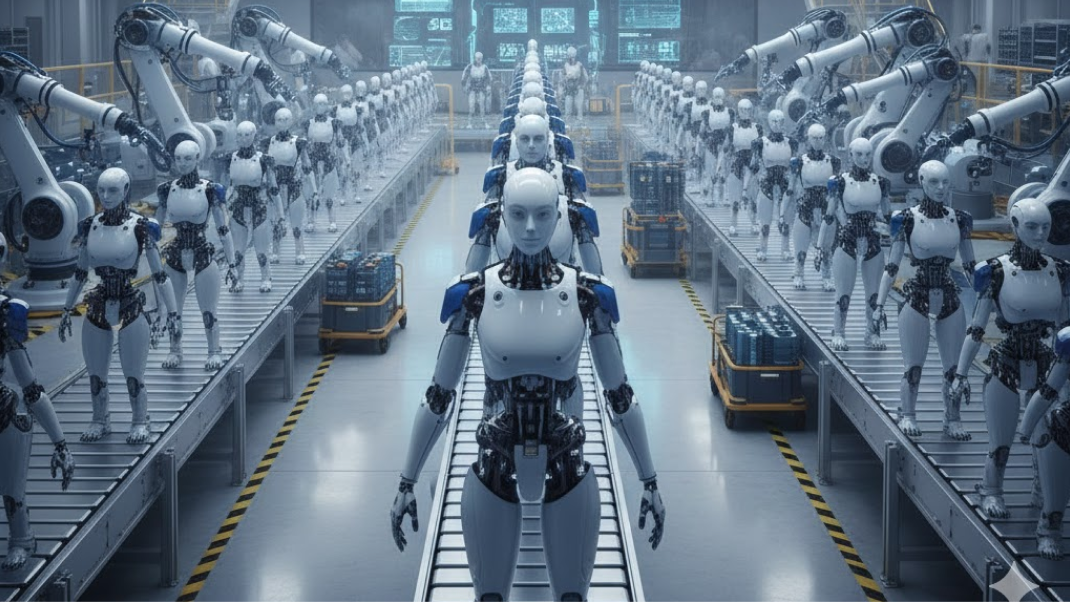
The global robotics market is surging toward $205.5 billion by 2030, growing from $90.2 billion in 2024 at a 15% compound annual growth rate. But beyond the impressive numbers, 2025 marks a historic inflection point: humanoid robots are transitioning from research prototypes to mass-produced commercial products, fundamentally transforming what's possible in automation and human-robot collaboration.
For decades, humanoid robots existed primarily in research labs and demonstration videos—impressive but impractical for real-world deployment. That changed dramatically in 2025:
Amazon's Millionth Robot: In July 2025, Amazon deployed its millionth robot across warehouses globally—a milestone demonstrating how quickly robotics can scale when economics and technology align.
Agility Robotics' Digit: Surpassed 100,000-tote milestone in commercial operation at GXO Logistics' Flowery Branch, Georgia facility. Digit's success in real warehouse operations—not controlled demos—proves humanoid robots can perform useful work reliably.
UBTech's Walker S2: Chinese robotics leader UBTech shipped the world's first mass batch of humanoid robot workers to active factories—hundreds of units deployed in commercial operations. This represents the genuine beginning of humanoid robot mass production and deployment.
Tesla's Optimus Progress: While not yet in production, Tesla's continued Optimus development and massive Giga Texas factory under construction signal upcoming large-scale humanoid manufacturing.
Figure AI's Challenges: A former safety engineer filed a wrongful-termination lawsuit alleging Figure's humanoid robots are "powerful enough to fracture human skull," highlighting safety challenges as powerful humanoids enter workplaces. This lawsuit underscores the critical importance of safety systems, regulatory frameworks, and liability considerations as humanoids scale.
Underlying the humanoid robot wave is the Physical AI market—projected to grow from $12.77 billion in 2023 to $124.77 billion by 2030. Physical AI represents AI systems that interact with physical environments: perceiving physical spaces and objects, planning and executing physical actions, learning from physical world feedback, and adapting to unpredictable real-world conditions.
Humanoid robots are the most sophisticated embodiment of Physical AI, requiring integration of computer vision, motion planning, force control, balance and stability, human-robot interaction, and continuous learning.
Humanoid form factors offer specific advantages that justify their complexity and cost:
Human Environment Compatibility: Buildings, tools, vehicles, and infrastructure are designed for human proportions and capabilities. Humanoid robots navigate these spaces without facility modification—critical competitive advantage over specialized robots requiring custom environments.
Tool Usage: Humanoid hands can use existing tools—power drills, screwdrivers, keyboards—eliminating need for custom robotic tooling. This dramatically expands applications and reduces deployment costs.
Social Acceptance: Humans instinctively understand and predict humanoid robot behavior, facilitating cooperation. Studies show people are more comfortable working alongside humanoids than other robot morphologies.
Versatility: A single humanoid platform can perform diverse tasks—assembly, inspection, material handling, cleaning—providing economic justification for higher upfront costs through multi-application flexibility.
Scalable Production: Unlike specialized robots requiring custom designs, humanoid platforms can be mass-produced, with differentiation through software and training rather than hardware. Tesla's vision of 10-million-per-year Optimus production exemplifies this scalability.
Q3 2025 marked a historic shift: robot orders in food and consumer packaged goods surpassed automotive manufacturing for the first time. This signals service robotics—applications outside traditional manufacturing—becoming the primary growth driver.
Service robotics includes logistics and warehousing (Amazon, DHL, and major retailers), food service and hospitality (restaurants, hotels deploying service robots), healthcare (surgical assistance, elder care, hospital logistics), retail (inventory management, customer service), agriculture (autonomous tractors, harvesting robots), and last-mile delivery (autonomous delivery robots scaling rapidly).
John Deere's "See & Spray" autonomous technology was used across 5 million acres in 2025—demonstrating precision agriculture's massive scale. This technology uses computer vision to identify individual plants, spraying only weeds while leaving crops untreated, reducing herbicide use by 66-90%, cutting costs while improving sustainability, and enabling organic farming at industrial scale.
Agriculture represents one of robotics' fastest-growing sectors, driven by labor shortages, sustainability pressures, precision farming economics, and climate adaptation requirements.
SoftBank's $5.4 billion acquisition of ABB Robotics (October 2025) ranks among the largest robotics acquisitions ever. SoftBank and Yaskawa Electric also signed an MOU to develop "Physical AI" robots for office environments.
This consolidation wave signals the market's maturation and recognition by financial powerhouses that robotics represents a trillion-dollar opportunity. Expect continued M&A as technology giants (Google, Amazon, Apple) acquire robotics capabilities, incumbent automation companies acquire AI startups, and private equity recognizes robotics' growth trajectory.
IBM predicts 2025 as "pivotal year for robotics" driven by developer adoption. Hugging Face entered robotics with open-source approaches, democratizing access to AI models for robotics applications. K-Scale Labs shipping K-Bot personal robots (December 2025) demonstrates new entrants rapidly commercializing robots using freely available AI tools.
This democratization accelerates innovation—thousands of developers and small companies can now create robotic applications that previously required massive R&D budgets.
Different regions show distinct robotics adoption patterns:
Asia Leads Deployment: China, Japan, and South Korea have the highest robot density (robots per 10,000 workers). China is the world's largest robotics market and manufacturing powerhouse.
North America Focuses on Innovation: US excels at robotics R&D, AI development, and service robotics innovation, though industrial robot deployment lags Asia.
Europe Balances Both: Germany leads industrial robotics (automotive, precision manufacturing) while Nordic countries pioneer service robotics (healthcare, elder care).
Middle East Emerging: UAE and Saudi Arabia are investing heavily in robotics for smart cities, logistics, construction, and oil & gas. NEOM envisions extensive robotic deployment, while Dubai's logistics sector rapidly automates.
As powerful humanoid robots enter workplaces, safety becomes paramount. Figure AI's lawsuit highlights real risks—robots capable of industrial work possess enough force to injure humans. The industry must address comprehensive safety systems (force limiting, collision avoidance, emergency stops), clear liability frameworks (who's responsible when robots cause harm?), regulatory standards (adapting workplace safety regulations for human-robot collaboration), insurance models (covering robotic operation risks), and public acceptance (building confidence in robot safety).
Countries and companies solving these challenges will lead humanoid robot adoption. Those ignoring safety will face accidents, lawsuits, and regulatory backlash slowing deployment.
Robotics' growth to $205.5 billion directly impacts employment, productivity, and economic structure. Some jobs—repetitive, dangerous, or physically demanding—will automate, but robotics creates new jobs in robot design and manufacturing, deployment and integration, maintenance and repair, AI training and supervision, and application development.
Studies suggest robotics ultimately creates more jobs than it displaces, while dramatically improving productivity, workplace safety, and economic output.
Key factors shaping robotics' path to $205.5 billion include continued AI advancement (better perception, manipulation, learning), cost reduction (making robots accessible to smaller businesses), regulatory evolution (clear frameworks enabling safe deployment), social acceptance (public comfort with robots in workplaces and homes), and infrastructure development (5G, edge computing, cloud robotics platforms).
For UAE and Saudi Arabia, robotics represents multiple strategic opportunities. Labor market dynamics (high dependence on expatriate labor) make automation economically attractive. Harsh environments (extreme heat, desert conditions) favor robots over human workers. Megaprojects (NEOM, Expo City Dubai) provide testbeds for robotic deployment at scale. Economic diversification (reducing hydrocarbon dependence) benefits from robotics-enabled manufacturing and services. Government support (funding, favorable regulations) accelerates adoption.
The robotics market's surge to $205.5 billion represents more than financial opportunity—it marks a fundamental transformation in how humanity works, produces, and lives. Humanoid robots transitioning from prototypes to mass production is a defining moment comparable to personal computers, smartphones, or autonomous vehicles.
Organizations, nations, and individuals that embrace this transformation will thrive. Those resisting will find themselves at severe competitive disadvantage. The robot revolution isn't future speculation—it's happening now, accelerating daily, and reshaping our world fundamentally.
The question isn't whether robots will transform society and economy—it's how quickly, and whether you'll lead the transformation or be forced to adapt to changes others drive.