
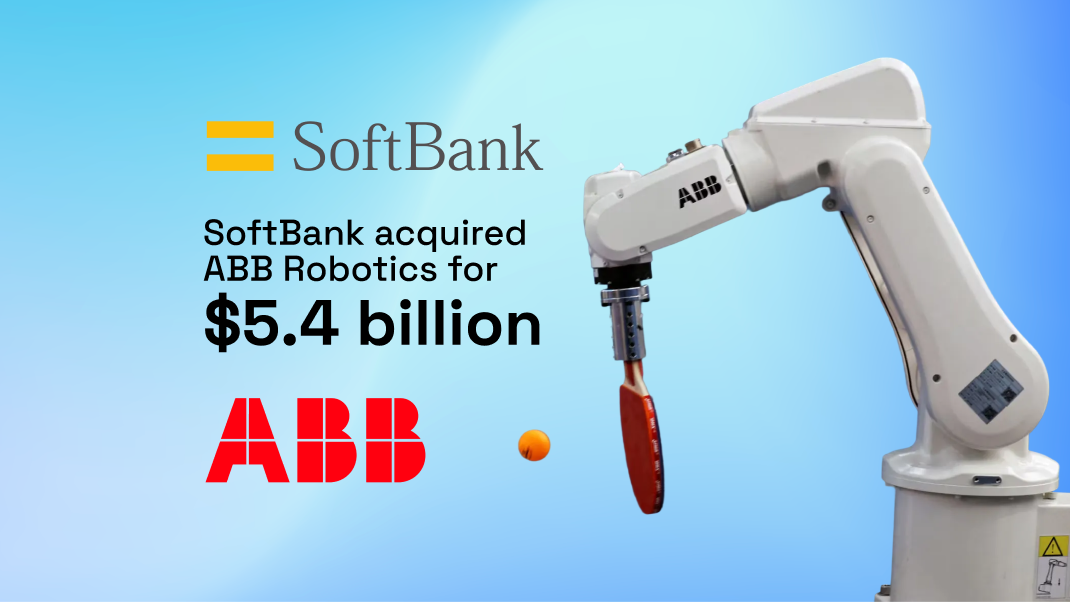
In October 2025, SoftBank Group Corp. acquired ABB Robotics for $5.4 billion, marking one of the largest robotics acquisitions in history and signaling that the robotics industry is entering a major consolidation phase. This landmark deal, combined with SoftBank and Yaskawa Electric's memorandum of understanding to develop "Physical AI" robots for office environments, demonstrates how financial powerhouses recognize robotics as the next trillion-dollar technology sector.
ABB Robotics is one of the world's leading industrial robotics companies with decades of manufacturing excellence. Founded in 1974 as ASEA's robotics division, ABB Robotics pioneered industrial automation and became a global leader with over 500,000 robots installed worldwide, serving automotive, electronics, logistics, healthcare, food & beverage, and general manufacturing industries.
ABB's portfolio spans industrial robot arms, collaborative robots (cobots), autonomous mobile robots (AMRs), robot controllers and software, industrial IoT connectivity, and AI-powered vision and optimization systems.
Their customers include virtually every major automotive manufacturer (BMW, Ford, Tesla, Volkswagen, Toyota), electronics giants (Apple, Samsung, Foxconn), consumer goods companies (Unilever, Procter & Gamble), and logistics leaders (Amazon, DHL).
SoftBank's $5.4 billion investment in ABB Robotics reflects several strategic priorities. First, diversification beyond telecommunications. SoftBank, historically focused on telecom and technology investments, is repositioning toward robotics, AI, and automation—sectors projected for explosive growth.
Second, proven business model. Unlike many SoftBank investments in startups, ABB Robotics is profitable with established customers, generating immediate returns while offering growth potential.
Third, integration with Vision Fund portfolio. SoftBank's Vision Fund has invested heavily in robotics and AI startups. Acquiring ABB provides manufacturing expertise, distribution channels, and customer relationships benefiting portfolio companies.
Fourth, physical AI opportunity. SoftBank sees "Physical AI"—AI systems interacting with physical environments—as a massive opportunity. ABB's industrial expertise combined with SoftBank's AI investments creates powerful synergies.
Fifth, Asian market strategy. ABB's strong European and American presence, combined with SoftBank's Asian networks, positions the combined entity for global leadership.
Simultaneously with the ABB acquisition, SoftBank and Yaskawa Electric signed an MOU to develop "Physical AI" robots for office environments. This partnership complements the ABB deal by targeting service robotics—distinct from ABB's industrial focus.
Office robotics represents a massive untapped market: cleaning and maintenance (automated janitorial services), delivery and logistics (moving documents, supplies, equipment), security patrol (mobile surveillance and incident response), reception and assistance (greeting visitors, providing information), and inventory management (tracking and organizing office supplies and assets).
The SoftBank-Yaskawa partnership aims to bring Yaskawa's robotics expertise to service applications powered by advanced AI. This represents a strategic pincer movement—ABB for industrial applications, Yaskawa partnership for service robotics.
SoftBank's ABB acquisition is part of a broader consolidation wave:
Siemens-Altair ($10.6B, October 2025): While focused on digital twins and simulation rather than robots per se, this mega-deal demonstrates technology giants recognizing that AI-powered industrial systems represent massive value.
Amazon's Boston Dynamics-Style Acquisitions: While not formally announced, industry analysts expect Amazon to acquire advanced robotics capabilities to complement internal development.
Automotive Companies Acquiring Robotics: Major automakers are acquiring robotics startups to secure automation capabilities and transition to electric vehicle manufacturing.
Private Equity Interest: Funds like KKR, Blackstone, and Carlyle are exploring robotics sector investments, recognizing the combination of growth and proven business models.
This consolidation reflects the market's maturation. Early-stage innovation is giving way to scale deployment, proven business models are attracting traditional investors, technological complexity favors companies with comprehensive capabilities, and customer demand supports premium valuations.
SoftBank's acquisition will ripple across the robotics industry in several ways:
Innovation Acceleration: SoftBank's financial resources enable ABB to accelerate R&D, particularly in AI, machine learning, and autonomous capabilities. Expect faster development cycles and more ambitious product roadmaps.
Market Consolidation: The $5.4 billion valuation sets benchmarks for robotics company valuations, likely triggering additional M&A as public and private companies seek liquidity events.
Competitive Pressure: Other industrial robotics leaders—FANUC, KUKA, Yaskawa—face a well-funded competitor backed by one of the world's most aggressive technology investors. This will likely accelerate their own innovation and M&A activities.
Customer Confidence: SoftBank's backing provides customers confidence in ABB's long-term viability, potentially accelerating purchase decisions and enabling larger, longer-term commitments.
Startup Ecosystem: SoftBank's emphasis on Physical AI suggests increased investment in robotics startups, particularly those focused on AI-powered physical world interaction.
The acquisition has distinct regional implications:
Asia-Pacific: SoftBank's Japanese headquarters and extensive Asian networks position ABB for accelerated growth in the world's largest robotics market. China, Japan, South Korea, and Southeast Asia represent enormous opportunities where local relationships matter.
Europe: ABB's Swiss heritage and strong European presence gain financial backing for competing against German rivals like KUKA (owned by Chinese Midea Group) and FANUC.
Americas: North America's manufacturing renaissance (driven by nearshoring and industrial policy) creates opportunities for ABB backed by SoftBank's resources.
Middle East: The Gulf region's automation ambitions—particularly NEOM and Dubai smart city initiatives—benefit from SoftBank's regional presence and ABB's industrial capabilities.
Central to SoftBank's robotics strategy is "Physical AI"—artificial intelligence systems that interact intelligently with physical environments. This represents the convergence of advanced AI (computer vision, reinforcement learning, large language models), robotics hardware (mechanical systems, sensors, actuators), edge computing (processing at the point of action), simulation (training AI in virtual environments), and human-robot collaboration (safe, intuitive interaction).
Physical AI enables robots to understand and navigate unstructured environments, learn new tasks through observation and practice, collaborate naturally with human workers, adapt to unexpected situations, and continuously improve through experience.
Despite the strategic logic, the acquisition faces challenges:
Integration Complexity: Merging ABB's Swiss engineering culture with SoftBank's fast-moving Japanese investment approach requires careful management. Cultural clashes could undermine synergies.
Technology Transitions: The robotics industry is rapidly evolving toward AI-driven systems. ABB's traditional industrial automation expertise must adapt to AI-first approaches without losing core strengths.
Regulatory Scrutiny: Large cross-border technology acquisitions face increasing regulatory review. European, American, and Asian authorities may scrutinize the deal's competition impacts.
Customer Concerns: Some ABB customers may worry about strategic direction changes or whether SoftBank's aggressive approach suits their conservative procurement practices.
Execution Risk: Realizing acquisition value requires successful execution—developing new products, integrating operations, retaining key personnel, and achieving revenue synergies.
For competing robotics companies, SoftBank's acquisition raises the stakes. Companies must innovate faster, seek their own strategic partnerships or acquisitions, invest more heavily in AI capabilities, and potentially prepare for acquisition themselves.
For ABB's customers, the acquisition brings opportunities and considerations. SoftBank's resources may accelerate innovation and product development, provide more comprehensive solutions, enable competitive pricing, but also require monitoring for strategic direction changes and ensuring continued support for existing installations.
SoftBank has indicated aggressive plans for ABB including accelerated AI integration, expanded product portfolio (particularly service robotics), geographic expansion (especially Asia), strategic acquisitions (ABB becoming an acquisition platform), and increased R&D investment.
Industry analysts project ABB's revenue could double within five years under SoftBank ownership, driven by market growth, share gains through innovation, geographic expansion, and new product categories (particularly Physical AI applications).
SoftBank's $5.4 billion acquisition of ABB Robotics represents a watershed moment for the robotics industry. It demonstrates that robotics has transitioned from niche industrial technology to mainstream strategic asset attracting blue-chip investors.
For the robotics industry, this signals maturation and consolidation. For investors, it validates robotics as a high-value sector. For technologists, it provides resources for ambitious innovation. And for society, it accelerates the robot revolution transforming work, manufacturing, and daily life.
The question is no longer whether robotics will transform the global economy—it's who will lead that transformation. With SoftBank's backing, ABB Robotics has positioned itself as a frontrunner in the race to define the robotic future.