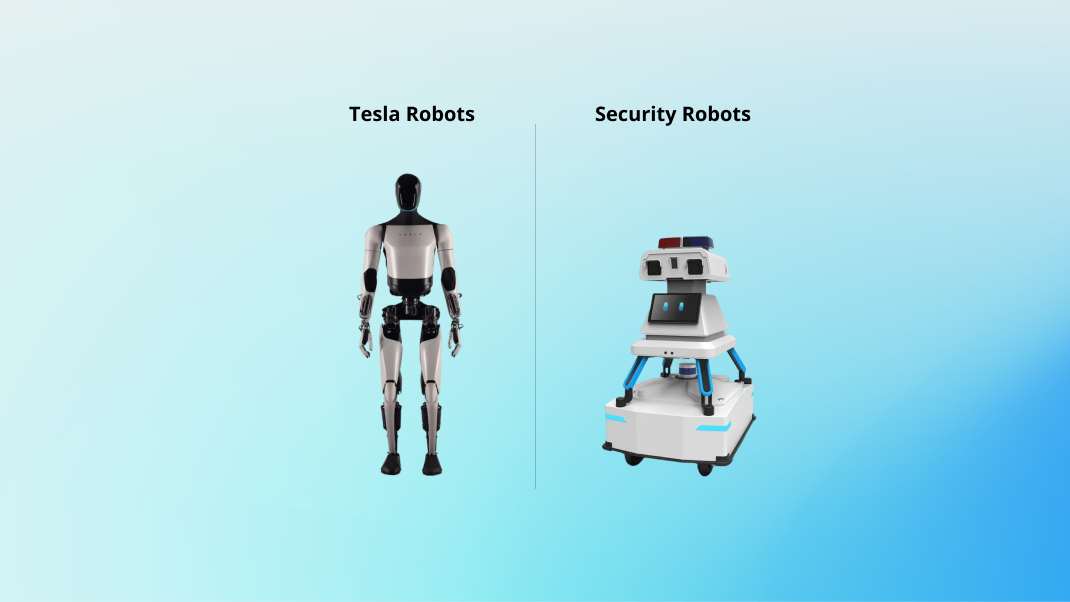
Tesla's Optimus humanoid robot and specialized autonomous security robots represent different approaches to autonomous technology, each optimized for distinct purposes. While both leverage AI, sensors, and autonomous operation, comparing them reveals important insights about robotics applications, design tradeoffs, and the future of autonomous systems. Let's examine how these technologies differ, what they share, and what each excels at.
The fundamental difference between Tesla Optimus and security robots lies in design philosophy.
Tesla Optimus: The Generalist: Tesla is developing Optimus as a general-purpose humanoid robot capable of performing diverse tasks. The design priorities include human-like form factor (enabling operation in human environments), dexterous manipulation (hands that can use tools), versatile locomotion (walking, climbing stairs, navigating obstacles), and adaptability (learning new tasks through AI).
Elon Musk envisions Optimus as eventually capable of anything a human can do—from factory work to household chores to elder care. This breadth requires tremendous complexity and capability but also compromises on specialization.
Security Robots: The Specialists: Dedicated security robots are purpose-built for surveillance and patrol. Design priorities include sensor optimization (cameras, thermal imaging, environmental monitors), efficient long-distance mobility (covering large areas on single charge), robust navigation (handling diverse indoor/outdoor environments), and security-specific features (deterrent appearance, emergency communications, evidence documentation).
Security robots sacrifice human-like versatility for excellence at specific security tasks. They can't fold laundry or assemble electronics, but they patrol facilities more effectively than general-purpose robots could.
This specialization-vs-generalization tradeoff is fundamental in robotics. Specialized robots achieve superior performance in their domains, while general-purpose robots offer flexibility at the cost of being sub-optimal for any specific task.
Movement capabilities differ dramatically between humanoid and security robots.
Tesla Optimus: Bipedal Locomotion: Optimus walks on two legs like humans, using complex balance control, dynamic gait adjustment, and energy-efficient walking. Advantages include navigating human environments (stairs, narrow passages, uneven terrain), using spaces designed for humans (standard doorways, floor clearances), and operating without facility modification.
However, bipedal walking is energy-intensive (consuming far more power per distance than wheels), mechanically complex (many joints requiring precise coordination), and slower than wheeled locomotion for covering large areas. For a robot that might need to quickly cross a warehouse to investigate an alert, legs are disadvantageous.
Security Robots: Wheeled or Tracked: Most security robots use wheels (indoor) or tracks (outdoor/rough terrain). Advantages include energy efficiency (5-10x more efficient than legs for distance travel), high speed (security robots can move 5-10 mph vs. Optimus's walking pace), simplicity (fewer failure points), and stability (no risk of falling).
The limitation is environmental access. Wheeled robots can't climb stairs or navigate very uneven terrain without specialized designs (though some advanced security robots have climbing capabilities). For single-floor patrol or outdoor perimeter monitoring, wheels are superior.
Some security robot designs use legs for specific applications requiring stair access or rough terrain navigation, but these are exceptions. Most security applications favor wheels' efficiency and speed.
Both robot types use sophisticated sensors, but with different emphases.
Tesla Optimus Sensors: Focus on manipulation and general task performance. Include high-resolution cameras for visual perception, tactile sensors in hands for manipulation, force/torque sensors for physical interaction, and inertial measurement for balance. The sensor suite is optimized for the robot to see what it's working on, feel objects it manipulates, and maintain balance during dynamic movements.
Security Robot Sensors: Focus on surveillance and threat detection over large areas. Include 360-degree camera coverage (observing all directions simultaneously), thermal imaging (detecting people in darkness or through obstacles), long-range visual sensors (identifying threats at 50-100+ meters), LiDAR for precise 3D mapping and navigation, environmental sensors (smoke, gas, temperature), audio sensors (gunshot detection, breaking glass, alarms), and license plate recognition for vehicle identification.
Security robots' sensor suites are far more extensive for surveillance purposes. They monitor wider areas with greater detail and detect threats human eyes or general-purpose cameras would miss. Optimus's sensors are sufficient for task performance but wouldn't provide comprehensive security monitoring.
Both systems leverage artificial intelligence, but optimized for different challenges.
Tesla Optimus AI: Focuses on manipulation, task learning, and physical interaction. Critical capabilities include object grasping and manipulation (picking up objects of varying shapes and sizes), task learning from demonstration (watching humans perform tasks and replicating them), balance and locomotion (walking stability, dynamic movement), tool use (learning to operate human tools), and human-robot interaction (understanding instructions, working alongside people safely).
Much of Optimus AI derives from Tesla's Full Self-Driving research—computer vision, path planning, and real-time decision-making in complex environments. However, manipulation AI is fundamentally different from driving AI and requires substantial additional development.
Security Robot AI: Focuses on threat detection, behavioral analysis, and autonomous patrol. Critical capabilities include computer vision for threat identification (weapons, suspicious packages, unauthorized individuals), behavioral analysis (detecting unusual activity patterns), facial recognition (identifying authorized vs. unauthorized personnel), anomaly detection (recognizing deviations from normal patterns), autonomous navigation with obstacle avoidance, and integration with security systems (alarms, access control).
Security AI is specialized for recognizing security-relevant patterns in sensor data and making decisions about patrol, investigation, and alerting. It's less concerned with physical manipulation and more focused on comprehensive environmental monitoring.
Battery capabilities differ significantly based on operational requirements.
Tesla Optimus: Expected to operate 5-8 hours on battery charge (based on Musk's statements and similar systems). This is sufficient for shift work in factories or homes but requires frequent charging. Bipedal walking and manipulation are energy-intensive, limiting endurance. Optimus will likely autonomously return to charging stations when needed, similar to robot vacuums.
Security Robots: Typically operate 12-24 hours on single charges, with some industrial models reaching 24+ hours. Extended endurance is critical for security applications—robots must patrol through entire overnight shifts without human intervention. Efficient wheeled mobility and optimized power management enable this extended operation.
Security robots that deplete batteries mid-patrol are useless. The operational requirement drives battery capacity far beyond what general-purpose robots need.
Pricing differs dramatically, though both are expensive.
Tesla Optimus: Target price around $20,000-$30,000 for production models (per Elon Musk's statements). This would be revolutionary—making humanoid robots affordable for businesses and potentially consumers. However, achieving this price at scale remains unproven. Early units will certainly cost more.
Security Robots: Current commercial security robots range from $50,000-$150,000+ depending on capabilities, sensors, and robustness. This higher cost reflects specialized sensors (thermal cameras alone cost $10,000+), ruggedized construction, and low production volumes compared to Tesla's planned scale.
If Tesla achieves their pricing targets, Optimus could disrupt the security robot market by offering general-purpose capability at lower cost. However, specialized security robots would still offer superior performance for dedicated security applications.
The right choice depends on requirements.
Many security applications would benefit from both: Optimus handling physical tasks (opening doors for inspection, manipulating objects) while specialized security robots provide comprehensive surveillance. The technologies are complementary, not necessarily competitive.
The Tesla vs. security robot comparison reflects broader tensions in robotics between general-purpose and specialized systems.
The Generalist Vision: Companies like Tesla, Figure AI, and Boston Dynamics pursue general-purpose humanoid robots that can ultimately perform any task humans can. The appeal is enormous—one robot platform serving countless applications, with differentiation primarily in software. If successful, this approach could revolutionize robotics economics through massive production scale.
The Specialist Reality: Specialized robots dominate today's market because purpose-built designs outperform generalists significantly. Industrial robots, surgical robots, warehouse robots, and security robots are all specialized and excel in their domains. The question is whether general-purpose robots will ever match specialized performance or whether tradeoffs inherent in generalization limit their effectiveness.
Likely Outcome: Both approaches will coexist. General-purpose robots like Optimus will handle diverse tasks where versatility matters more than peak performance. Specialized robots will continue dominating applications where performance, reliability, or specific capabilities (like security robots' sensor suites) are critical.
Security might even deploy both—Optimus handling physical security tasks (checking locked doors, investigating physical anomalies) while specialized security robots provide comprehensive surveillance and patrol.
Despite different focuses, Tesla robotics and security robots inform each other.
From Tesla to Security: Tesla's advances in computer vision (trained on billions of miles of driving data) translate to security robots. Path planning algorithms, obstacle avoidance, and AI decision-making developed for self-driving apply to autonomous patrol. Battery management and power efficiency innovations improve security robot endurance.
From Security to Tesla: Security robots' advances in 360-degree sensing, thermal imaging integration, and human detection in cluttered environments enhance Optimus capabilities. Long-endurance operation techniques and ruggedized designs inform Optimus development for demanding applications.
The entire autonomous robotics field benefits as innovations in one domain spread to others.
Looking forward, interesting convergence scenarios emerge.
Scenario 1: Optimus Enters Security: If Tesla achieves production scale and target pricing, Optimus could disrupt security robotics by offering general-purpose capability at breakthrough cost. Security applications might use Optimus equipped with security-specific sensors and software—humanoid form factor with specialized security AI.
Scenario 2: Security Robots Add Manipulation: Specialized security robots might add manipulation capabilities (robotic arms) for tasks like opening doors, pressing elevator buttons, or even restraining intruders. This would maintain surveillance specialization while adding versatile physical interaction.
Scenario 3: Ecosystem Deployment: Facilities deploy both—specialized security robots for primary surveillance/patrol, Optimus for physical security tasks requiring manipulation. The systems coordinate through shared software platforms, creating comprehensive security solutions leveraging each platform's strengths.
The most likely outcome is Scenario 3: Both specialized and general-purpose robots find niches where they excel, with integration enabling capabilities neither could achieve alone.
Tesla Optimus and specialized security robots represent different philosophical approaches to autonomous systems—generalist versatility vs. specialist excellence. Optimus aims to match human versatility, using humanoid form factor and manipulation capability to handle diverse tasks. Security robots sacrifice versatility for surveillance excellence, using optimized sensors, efficient mobility, and security-specific AI to patrol effectively.
Neither approach is inherently superior—the right choice depends on requirements. For dedicated security applications requiring comprehensive surveillance, long endurance, and specialized sensors, purpose-built security robots remain optimal. For applications requiring versatile physical task performance alongside security functions, general-purpose humanoids like Optimus may prove more cost-effective.
The real question isn't which is better, but how both technologies will evolve and potentially integrate. The autonomous robotics future likely includes both specialists and generalists, each excelling in their domains while learning from each other's innovations.
For organizations evaluating autonomous security solutions today, specialized security robots remain the proven choice. But watching Tesla's progress with Optimus—and considering how general-purpose humanoids might eventually complement or compete with specialized systems—is essential for long-term strategic planning.
The robotics revolution is unfolding through multiple paths, and both general-purpose and specialized approaches will shape that future.