
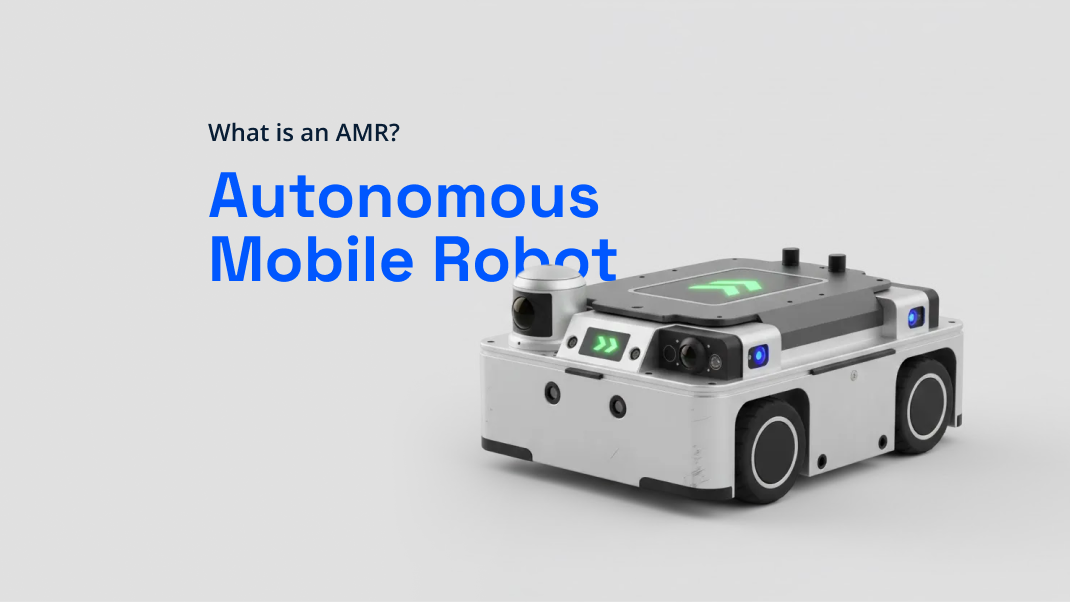
An Autonomous Mobile Robot (AMR) is a robot that can understand and navigate through its environment without continuous human guidance or fixed infrastructure. AMRs combine three essential capabilities: autonomous navigation using onboard sensors and AI, mobile platform moving freely through facilities, and intelligent decision-making adapting to changing conditions.
Unlike older Automated Guided Vehicles (AGVs) that follow magnetic strips or wires, AMRs use sophisticated sensors and artificial intelligence to perceive their surroundings, understand where they are, plan efficient paths, avoid obstacles dynamically, and adapt to environmental changes.
AMRs perceive their environment through multiple sensor types:
LiDAR (Light Detection and Ranging): Laser sensors creating 3D maps of surroundings with centimeter-level precision.
Cameras: Visual sensors for object recognition, QR code reading, and human detection.
Ultrasonic Sensors: Short-range sensors detecting nearby obstacles.
IMU (Inertial Measurement Unit): Tracking the robot's own movement, acceleration, and orientation.
These sensors work together through "sensor fusion"—combining data streams into comprehensive environmental understanding more accurate than any single sensor provides.
The core technology enabling AMR autonomy is SLAM (Simultaneous Localization and Mapping):
Mapping: As AMRs explore facilities, they build detailed maps using sensor data, identifying distinctive features (walls, doorways, columns), and creating spatial reference frameworks.
Localization: Once a map exists, AMRs continuously determine their position by comparing current sensor readings to stored maps, triangulating position based on recognized features, and maintaining location accuracy even when moving.
Simultaneous Operation: AMRs perform mapping and localization simultaneously—the famous "chicken and egg" problem that SLAM algorithms solve elegantly.
AMRs plan optimal routes from current location to destination considering shortest distance, obstacle avoidance, traffic (other robots, people, vehicles), charging needs (returning to stations when battery runs low), and task priorities (urgent deliveries first).
Modern AMRs replan continuously—if a person blocks the corridor or a door is unexpectedly closed, AMRs instantly calculate alternative routes without human intervention.
Real-time obstacle avoidance distinguishes AMRs from AGVs. AMRs detect dynamic obstacles (people, forklifts, dropped objects), predict movement of mobile obstacles (a person walking toward the robot), adjust speed and trajectory to avoid collisions, and maintain safe distances from humans.
This enables AMRs to operate safely in active facilities with people, forklifts, and constantly changing conditions—impossible for fixed-path AGVs.
Understanding AMRs requires distinguishing them from older AGV technology:
Navigation: AGVs follow fixed paths (magnetic tape, wires), AMRs navigate freely using onboard sensors and maps.
Flexibility: AGVs require facility modification (installing guides), AMRs adapt to facilities as-is.
Adaptability: AGVs stop when paths are blocked, AMRs route around obstacles automatically.
Deployment Time: AGVs take weeks to install infrastructure, AMRs deploy in days.
Change Management: AGV path changes require physical reconfiguration, AMR route updates happen through software.
Cost: AGVs have lower robot costs but higher installation costs, AMRs have higher robot costs but minimal installation expenses—often equalizing total cost while providing far greater flexibility.
Manufacturing: Moving components between assembly stations, transporting finished goods to shipping, delivering tools and materials to work cells, removing waste and recyclables.
Warehousing and Logistics: Transporting inventory from storage to picking stations, moving picked orders to packing and shipping, restocking inventory, sorting packages.
Healthcare: Delivering medications from pharmacies to nursing stations, transporting lab samples, moving linens and supplies, waste disposal.
Hospitality: Room service delivery in hotels, luggage transport, cleaning supply distribution, food and beverage service.
Retail: Inventory replenishment from back rooms to shelves, moving e-commerce orders within stores, trash and recycling collection.
Food Service: Ingredient transport in commercial kitchens, food delivery to tables (restaurants), waste removal, dishware return.
Each industry has unique requirements that AMRs address through flexible, adaptable automation impossible with traditional AGVs.
Most real-world AMR deployments involve fleets—multiple robots working coordinately. Fleet management software provides task assignment (distributing jobs efficiently across available robots), traffic management (preventing congestion and collisions), charging coordination (ensuring coverage continues as robots charge), performance monitoring (tracking productivity and identifying issues), and continuous optimization (improving efficiency based on operational data).
Advanced fleet management uses AI to predict demand, optimize robot quantities and positioning, and identify process improvement opportunities—enabling organizations to continuously enhance operations.
Increased Productivity: AMRs work 24/7 without breaks, fatigue, or distractions, handling repetitive transport tasks freeing humans for value-adding work.
Cost Reduction: Labor cost savings, reduced errors and damage, improved facility utilization (optimized workflows).
Safety Improvement: Reducing human exposure to hazardous transport tasks (heavy loads, forklift traffic).
Scalability: Easy to add robots as operations grow, flexible deployment across multiple facilities, seasonal scaling up/down.
Data and Analytics: AMRs generate operational data revealing bottlenecks, inefficiencies, and optimization opportunities invisible with manual processes.
AMR deployment isn't without challenges:
Upfront Investment: While ROI is often strong, initial costs require capital or financing.
Integration Complexity: Connecting AMRs with warehouse management systems, ERP, and other software.
Change Management: Training staff, adjusting workflows, overcoming resistance.
Environmental Requirements: AMRs work best with clear floors, adequate lighting, and Wi-Fi coverage.
Vendor Selection: Choosing appropriate AMR technology and reliable suppliers.
Successful deployments address these challenges through careful planning, phased implementation, and strong vendor partnerships.
UAE and Saudi Arabia represent exceptional AMR markets:
Logistics Growth: Massive logistics expansion (Dubai's role as global trade hub, Saudi Vision 2030 logistics strategy) creates ideal AMR applications.
Labor Market Dynamics: High reliance on expatriate labor makes automation economically attractive.
New Facility Construction: Building new warehouses and facilities enables AMR-optimized designs from inception.
Technology Adoption: Government support for advanced technology accelerates AMR deployment.
Extreme Conditions: Indoor climate control makes Middle East facilities ideal for AMR operation (avoiding outdoor heat challenges).
AMR technology continues advancing rapidly:
AI Improvements: Better obstacle detection, path planning, and decision-making.
Manipulation Capabilities: Robotic arms added to AMR platforms for pick-and-place operations.
Outdoor Operation: Ruggedized AMRs for outdoor logistics, construction sites, agriculture.
Human Collaboration: More sophisticated interaction with human workers.
Standardization: Industry standards enabling multi-vendor interoperability.
Autonomous Mobile Robots represent a fundamental advancement over older automated guided vehicles—providing flexibility, adaptability, and capabilities that transform logistics, manufacturing, healthcare, and countless other operations.
Understanding AMRs—what they are, how they work, where they excel—is essential for organizations evaluating automation options. As technology improves and costs decline, AMRs will become increasingly ubiquitous across industries.
For organizations in the Middle East pursuing operational excellence and digital transformation, AMRs offer proven technology delivering measurable results. The question isn't whether to adopt AMRs, but when and how to implement them most effectively.